


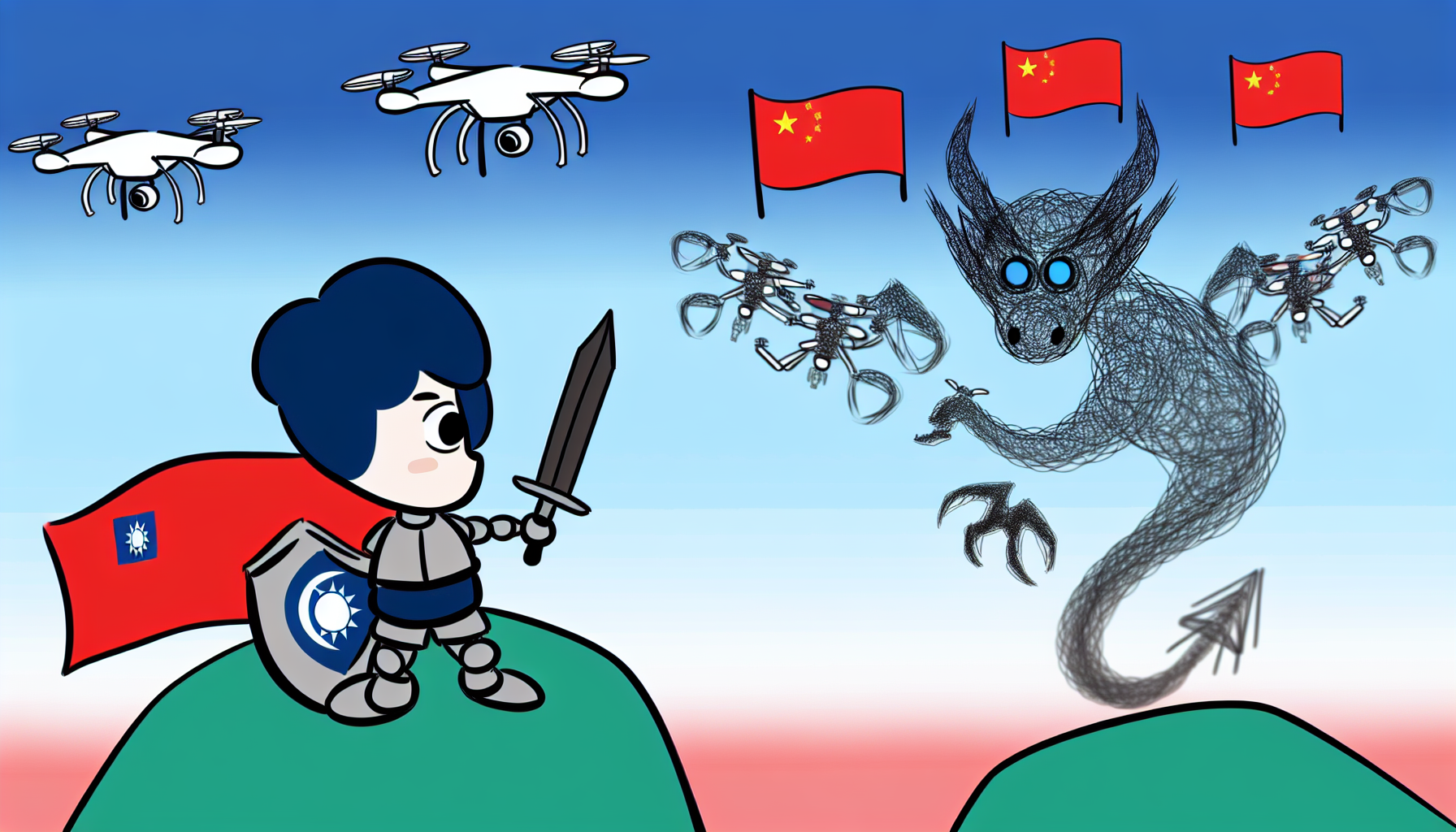
Taiwan’s Strategic Drone Expansion Amid Rising Tensions with China
Taiwan is actively expanding its military and commercial drone capabilities in response to increasing pressure from China, which has been modernizing its military with the explicit goal of potentially annexing the self-governing island by 2027. The recent discussions among defense experts highlight Taiwan’s urgency to bolster its unmanned aerial systems and the strategic insight shaped by global events like the ongoing Russia-Ukraine conflict.
The Threat Landscape
In a panel hosted by the Center for a New American Security, experts explored Taiwan’s plans to enhance domestic drone production and integrate them into a comprehensive defense strategy. “China now has dominance over many components used in drones,” remarked Hong-Lun Tiunn, a fellow at the Research Institute for Democracy, Society and Emerging Technology. This dependency underscores the urgency for Taiwan to develop its own supply chain to manufacture quality components and drone models independently.
Historical Context
Taiwan has operated under a self-governing framework for over 75 years, but its sovereignty is not recognized by China, which considers the island a part of its territory. Tensions have escalated markedly in recent years, particularly after Chinese President Xi Jinping articulated his intent to prepare the People’s Liberation Army for a potential “unification” scenario with Taiwan. Ely Ratner, former U.S. assistant secretary of defense for Indo-Pacific security affairs, emphasized that while 2027 is viewed as a modernization goal for China, actual military maneuvers will depend on specific conditions being met.
China’s Military Buildup
China is not only focusing on Taiwan but is also involved in territorial disputes with other regional neighbors. In this landscape, it’s accelerating the development of various military assets, including drones, long-range strike capabilities, and advanced cyber systems. As defense expert Stacie Pettyjohn stated, “China has invested very heavily in uncrewed systems of all types,” while keeping a keen eye on the developments in Ukraine, hinting at the critical role drones will likely play in future conflicts.
Taiwan’s Drone Production Goals
With aspirations to produce 180,000 drones annually by 2028, Taiwan has set ambitious targets to bolster its defense nexus. Tiunn outlined that, despite the urgency, the current production capacity stands at around 10,000 units per year, which falls short of achieving the new goal. He pointed out that the dynamics of warfare would evolve significantly after the initial exchanges of conflict, making it crucial for Taiwan to have a sustainable supply of munitions and repair capabilities.
“Drones will be a key part of Taiwan’s defensive strategy,” Tiunn noted, emphasizing the importance of creating a self-sufficient framework to ensure continued resistance in the event of a conflict.
U.S. Support and Initiatives
The United States plays a pivotal role as a primary arms provider for Taiwan. Despite this, some analysts express concern over whether Taiwan is maximally optimizing its weapons acquisitions to address future conflict scenarios adequately. The discussions at the CNAS panel illustrated how U.S. support is crucial but must be aligned with Taiwan’s own strategic objectives.
Experts pointed out that the Pentagon’s Replicator initiative aims to modernize U.S. military readiness and leverage rapid production capabilities for drones and other technologies. Tiunn confirmed that Taiwan’s drone development strategies have drawn significant inspiration from this initiative, aiming to streamline procurement processes to ensure that modern drones can be integrated into military operations swiftly.
Future Considerations
As Taiwan aligns its military strategies with evolving geopolitical realities, the focus on drones reflects a more extensive shift in military doctrine. Pettyjohn suggested that Taiwan should embrace autonomy, leveraging drones for both combat and reconnaissance purposes. She anticipated a gender shift in military operations towards more electronic warfare tactics in the event of a conflict with China.
In this transitional phase, Taiwan recognizes that sustaining its production capabilities and adapting its military posture will be essential for long-term resilience against external threats.