


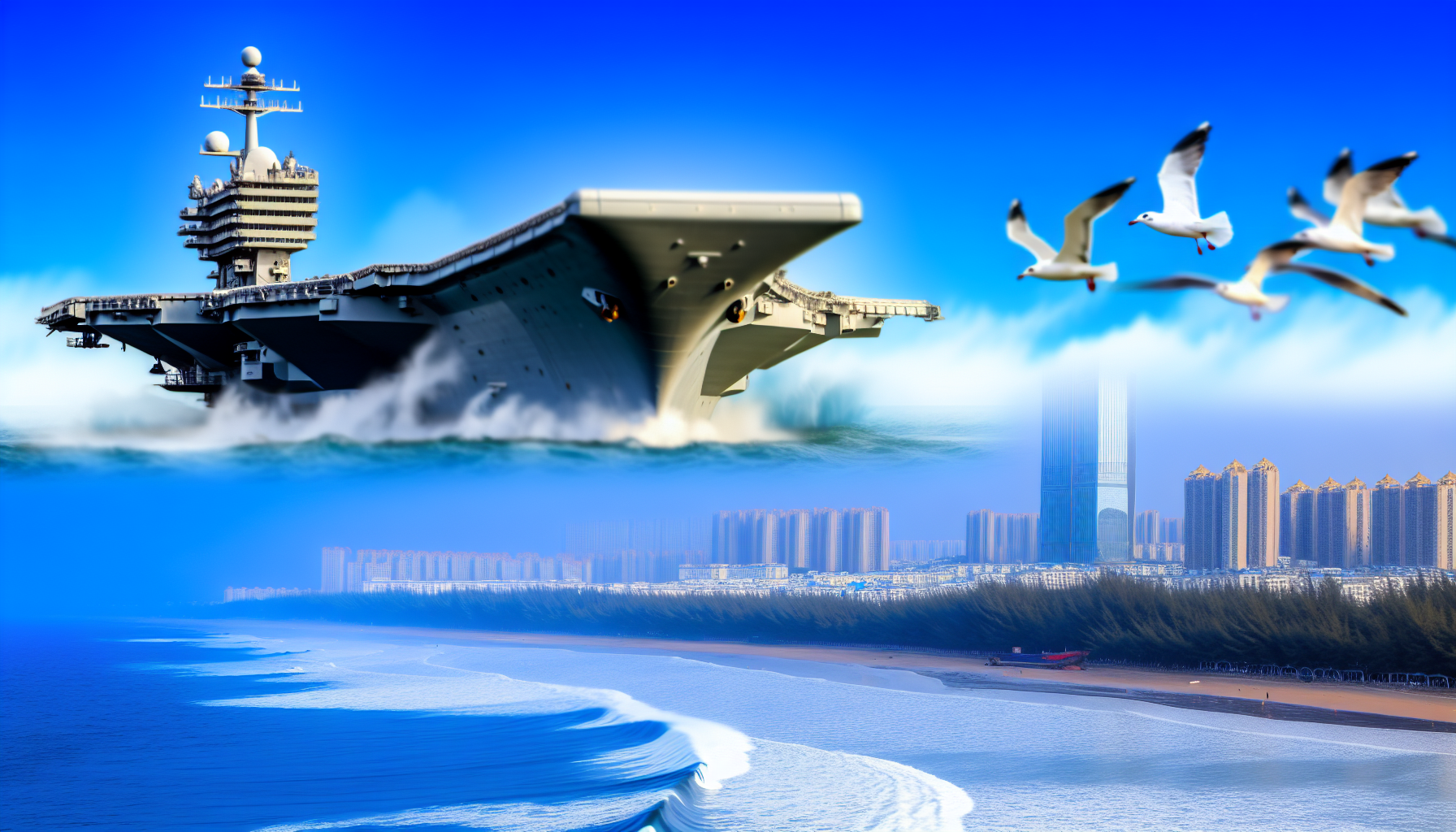
On a significant Wednesday in the southern city of Sanya, China unveiled its third aircraft carrier, the Fujian. This marks a pivotal moment in the evolution of the People’s Liberation Army Navy (PLAN), as the Fujian is not only China’s most advanced warship but also pivotal for military strategy in the region.
The carrier, designated with hull number 18, is notable for being equipped with electromagnetic catapult technology, a feature that places China alongside the United States as a leader in modern naval warfare. Unlike traditional catapults, this advanced technology allows for quicker launch times and improved aircraft deployment, increasing the operational efficiency of the vessel immensely.
The Fujian represents a critical step for China’s naval ambitions, aimed at asserting its military presence beyond its immediate borders. The commissioning of the Fujian is symbolic of China’s growing industrial capabilities and military modernization efforts, reinforcing the nation’s strategic goals on the global stage.
China’s Homegrown 80,000-Ton Aircraft Carrier
The commissioning ceremony was presided over by President Xi Jinping, who took the opportunity to board the vessel and receive briefings on its sophisticated combat systems. Attendees included high-ranking military officials such as General Zhang Shengmin, the deputy chairman of the Central Military Commission, and Vice Premier Zhang Guoqing, underscoring the seriousness with which China views this event.
Weighing in at over 80,000 tons, the Fujian stands as the largest non-nuclear warship globally. It began its sea trials in May 2024, approximately two years post-launch, highlighting China’s capacity for rapid military advancements. This timeline, while longer than its predecessor, the Shandong, is still quicker than the construction and commissioning duration of the U.S. Navy’s USS Gerald R. Ford, indicating a significant leap in China’s naval manufacturing prowess.
One of the most significant features of the Fujian is its electromagnetic catapults, a step-up from the older ski-jump decks found on previous carriers like the Liaoning and Shandong. These catapults enable the carriage of heavier payloads and facilitate quicker launches and greater sortie rates, adding considerable operational flexibility to the carrier’s capabilities.
Powered by Progress: Electromagnetic Catapult Technology
The Fujian is expected to support a versatile mix of aircraft, including J-35A stealth fighters, J-15T heavy carrier fighters, and J-15DT electronic warfare craft, along with the KJ-600 early warning and control aircraft. In tests conducted in September, all three aircraft successfully performed catapult-assisted takeoffs and arrested landings, demonstrating the carrier’s advanced operational capabilities.
The J-35, developed by Shenyang Aircraft Corporation, is China’s first carrier-based stealth fighter and one of the few globally, alongside Lockheed Martin’s F-35C. This adds a new dimension to China’s aerial combat capabilities, allowing them to project power with stealth technology.
Although the advancements with the Fujian signal momentum in China’s naval aspirations, military experts caution that challenges remain. Song Zhongping, a military analyst and former PLA instructor, noted that while the Fujian enhances operational capabilities, the fleet of three aircraft carriers is still limited. He emphasizes that performance, quantity, and combat experience are crucial factors for effectively countering potential adversaries in key areas such as the Taiwan Strait.
Song acknowledged the crucial integration of fixed-wing and helicopter aircraft onboard the Fujian, enhancing the PLAN’s versatility and operational efficacy. However, achieving full readiness for combat operations will necessitate extensive training and experience.
With the Fujian now officially operational, China showcases its military growth against a backdrop of recent military parades emphasizing advanced capabilities and technology. The ship’s commissioning is a clear indication of the nation’s intention to continually expand and modernize its naval fleet, reinforcing its strategic posture in the Indo-Pacific region and positioning itself as a formidable naval power.