


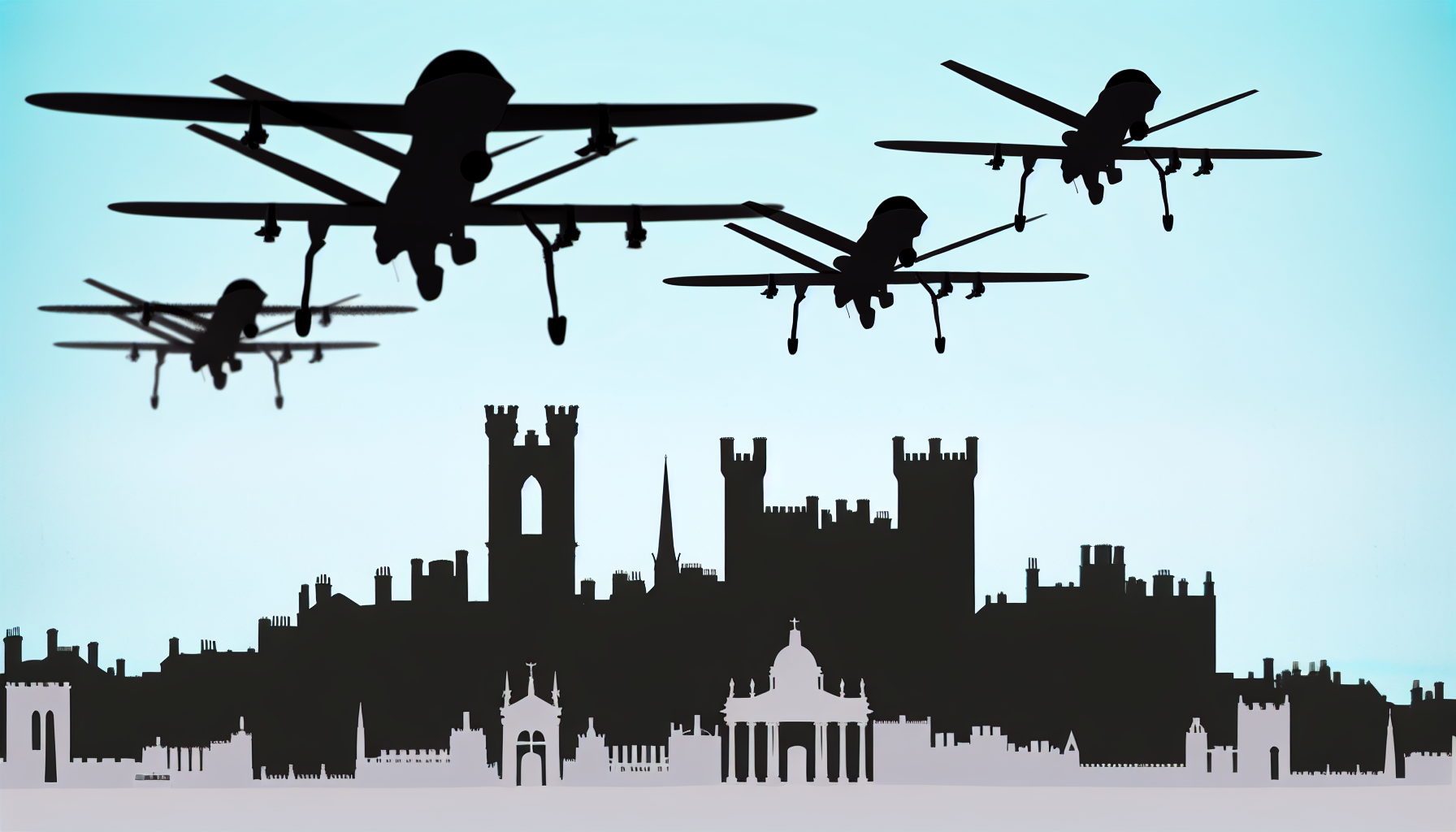
In an alarming incident overshadowing a significant diplomatic visit, four unidentified military-style unmanned aerial vehicles breached a no-fly zone near Dublin Airport, placing themselves dangerously close to the arrival route of Ukrainian President Volodymyr Zelensky. This timely event raised security concerns and prompted immediate investigations into the origins and intentions of the drones.
The Journal reported that the drones were launched from the northeastern side of Dublin, likely near the picturesque coastal area of Howth. These aerial devices remained airborne for approximately two hours, sparking a flurry of questions about their origin—whether they were launched from land or possibly from an undisclosed vessel at sea. The fact that they approached the area where President Zelensky’s plane was scheduled to land only heightened tensions during an already politically charged visit.
As the drones circled near Dublin Airport, they later drifted over the LÉ William Butler Yeats, a vessel deployed by the Irish Naval Service to ensure the safety and security of the President during his visit. The military-grade drones, equipped with lights, hinted at a potential strategy to disrupt the aircraft’s arrival. However, no concrete information has emerged about the identity of the operators or their current location.
Investigation and Consequences
The incident sparked a rapid response from the Irish government, leading to a high-level meeting involving An Garda Síochána, the Irish Defence Forces, and officials responsible for national security. This swift assembly underscores the seriousness with which such breaches of airspace are taken, especially concerning the safety of a head of state. They evaluated the situation, including the potential threats posed by the drones, alongside the necessary precautions that needed to be implemented.
Despite the tensions caused by the drones, President Zelensky’s visit proceeded without any significant complications. His aircraft utilized a specialized takeoff protocol from Dublin, designed to mitigate any risks associated with the potential drone threat. The Irish Aviation Authority reacted decisively, imposing a no-fly zone over Dublin and surrounding areas throughout the duration of the visit, highlighting the urgency of protecting national and international figures.
While the investigation continues, details about the drones are increasingly becoming clearer. Eyewitness accounts and preliminary assessments suggest that they were likely quadcopters, characterized by their four propellers. However, the operational capabilities of these drones raised another layer of concern, as they were autonomously controlled, likely by four pilots managing them from a distance.
The Irish security forces faced significant challenges in responding to the intrusion. LÉ Yeats, which provided maritime security, lacked the onboard radar equipment necessary for detecting airborne threats, highlighting a potential vulnerability in national security practices. As the drones operated autonomously, the absence of immediate countermeasures posed further questions about preparedness in the face of such incidents.