


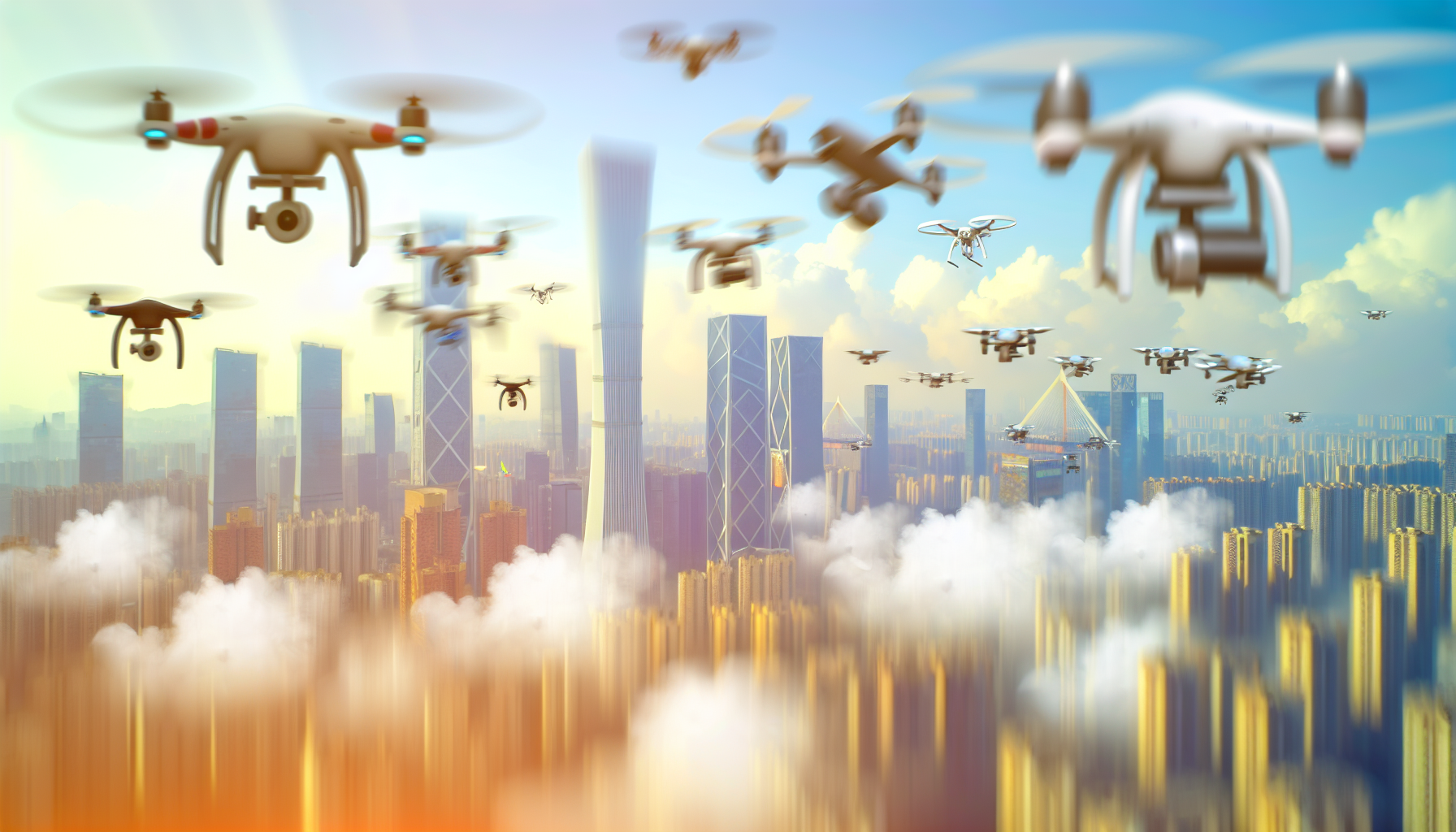
Why China Is Leading the Global Drone Revolution
For much of the 20th century, drones and flying cars existed solely in the realm of science fiction. Visionaries imagined skies overflowing with unmanned aircraft gliding above futuristic megacities. Fast forward to today, and that vision has transformed into reality—though not in the United States, as many would have predicted, but in China.
Drones in Daily Life
Across numerous Chinese cities, drones have seamlessly integrated into daily routines. They deliver meals to rooftop stations, transport blood samples to hospitals, spray fertilizers on crops, map disaster zones, and even assist in emergency rescues in hard-to-reach locations. What was once confined to the pages of science fiction has become a vital part of China’s infrastructure, both urban and rural.
The Rapid Growth of Drone Numbers
The numbers tell a striking story. According to The Economist, China operated 2.2 million civilian drones in 2024—a remarkable 455% increase over just five years. This surge isn’t coincidental; it results from strategic, state-driven initiatives aimed at nurturing what Beijing terms its “low-altitude economy.”
Government Support and Regulatory Reforms
To facilitate the rapid adoption of drones, China has restructured its airspace regulations, encouraged provinces to test commercial drone operations, and invested heavily in local manufacturing. These efforts have paid off, as China now dominates the global commercial drone market, producing over 70% of the world’s drones, per Drone Industry Insights.
The Emergence of eVTOLs
The momentum doesn’t stop with conventional drones. Electric vertical takeoff and landing aircraft (eVTOLs), often referred to as flying cars, are also coming to fruition. Chinese companies like EHang have secured early certifications and are poised to launch commercial services soon—far ahead of their Western counterparts.
U.S. Regulatory Roadblocks
While the U.S. played a pivotal role in the early days of aviation and military drones, its commercial drone industry faces significant restrictions. Most American drone services consist of limited pilot programs restricted to only a few cities. The primary barrier remains regulatory: until recently, the FAA mandated most commercial drones to operate within the visual line of sight, hindering scalability.
Although the FAA has proposed easing these constraints, progress remains slow. In contrast, Chinese regulators have created a permissive environment that encourages real-world testing and implementation.
Public Sentiment and Cultural Attitudes
Cultural perspectives also differ drastically between the two nations. A survey by McKinsey revealed that 86% of Chinese respondents expressed a willingness to use drone delivery services, compared to just 53% of Americans. This cultural comfort with emerging technologies has facilitated rapid adoption in China.
DJI: The Dominant Force
At the heart of China’s drone revolution is DJI, a Shenzhen-based giant that holds approximately 80% of the U.S. commercial drone market. The company’s success stems from its user-friendly design, innovative technology, and competitive pricing—attributes that its rivals struggle to replicate.
National security concerns in the U.S. are mounting due to DJI’s dominance. Legislation is underway in Congress that could limit imports of DJI drones, potentially disrupting the majority of drone operations used by American police departments, filmmakers, inspectors, and agriculturalists.
The Concept of “Process Knowledge”
According to Dan Wang in his book, Breakneck: China’s Quest to Engineer the Future, China’s advantage in the drone sector isn’t primarily due to groundbreaking scientific discoveries, but rather its proficiency in “process knowledge.” This practical expertise gained through large-scale manufacturing enables swift innovation, cost reductions, and effective supply chain integration.
Shenzhen: The Hardware Silicon Valley
This theory is exemplified in Shenzhen, often dubbed the “Silicon Valley of hardware.” In this compact ecosystem, drone startups have immediate access to advanced batteries, sensors, motors, cameras, and rapid prototyping facilities. The historical context of Shenzhen as a hub for Apple suppliers has transitioned into a thriving center for robotics and drone innovation.
The Broader Technological Divide
Drones represent just one facet of a growing technological chasm between the U.S. and China. While the U.S. intensifies its investment in advanced artificial intelligence with long-term goals like artificial general intelligence (AGI), China is aggressively applying AI to physical realms—automating factories, deploying humanoid robots, and expanding drone operations across various sectors.
A Shift in Emerging Technologies
China’s swift deployment of drones and aerial vehicles signifies a crucial transformation in translating emerging technologies from theory to practical application. The drone-laden future envisioned decades ago is now being realized—yet not in the ways many had anticipated.
For the U.S. to remain competitive, it will need more than just technological advancements; it will require regulatory reforms, a coherent industrial strategy, and a commitment to turning innovative concepts into tangible realities. As it stands, China is soaring ahead in the race to integrate AI and robotics into its economy.