


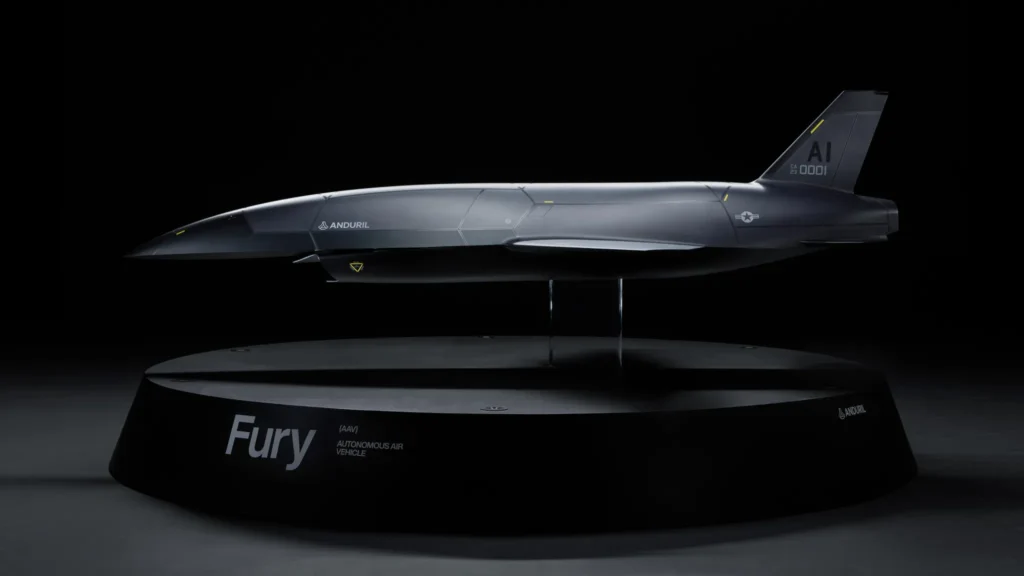

The U.S. Air Force has officially entered a new era of aerial warfare with the successful test flight of its semi-autonomous combat drone, the Fury. Officially designated as the YFQ-44A, this next-generation aircraft is not just another drone; it’s a glimpse into how artificial intelligence and automation are reshaping the future of war. Designed to fly alongside piloted fighter jets, Fury represents a historic milestone in the military’s push toward smarter, more adaptable, and cost-effective air combat systems.
A New Breed of Combat Aircraft: How the ‘Fury’ Works
Unlike traditional drones that are entirely operated from the ground, Fury is built to think for itself. Developed under the U.S. Air Force’s Collaborative Combat Aircraft (CCA) program, the drone can perform various missions, including surveillance, escorting fighter jets, and direct engagement in combat. Its AI-based systems allow it to operate with minimal human input, an evolution that gives it semi-autonomous control during high-speed, high-risk missions.
Fury’s main task is to serve as a “loyal wingman,” flying in formation with crewed aircraft such as the F-35 or F-15EX. It can detect enemy threats, share data in real-time, and even take offensive action when commanded. Although the U.S. Air Force has not yet released specific technical details, Fury is believed to possess advanced stealth capabilities and an impressive operational range, making it suitable for missions previously considered too dangerous or costly for human pilots.
The AI Revolution in the Sky: A Historic Leap for the U.S. Air Force
What makes Fury so revolutionary is its integration of artificial intelligence into real-world military operations. The AI system onboard doesn’t replace human pilots but enhances their capabilities. It can interpret mission data, predict threats, and make split-second decisions faster than any human could.
This advancement represents a turning point for U.S. defense strategy. The Pentagon has made clear that future wars will rely not only on the skill of pilots but also on the intelligence of machines that can learn and adapt in real time.
The project also highlights the responsible use of AI; human operators maintain oversight and control, ensuring that the drone’s actions align with military ethics and command decisions. This achievement underscores how far military technology has come and how close AI is to becoming a central player in defense systems worldwide.
Building the Future Fleet: Mass Production and Industrial Strategy
Beyond its technological marvel, Fury symbolizes a broader industrial shift. The Collaborative Combat Aircraft program aims to produce large fleets of affordable, easily replaceable, and adaptable drones. Rather than relying solely on a few high-cost fighters, the U.S. Air Force plans to field hundreds of Furies that can support crewed aircraft across a wide range of missions — from air dominance to electronic warfare.
This strategy prioritizes mass production and modular design, allowing each drone to be tailored for specific combat needs. The goal is to achieve numerical superiority and flexibility at a fraction of the cost of traditional fighter jets.
If successful, this model could redefine the economics of air warfare, where quantity, speed of deployment, and AI coordination become decisive factors. The Fury’s development also showcases close collaboration between the Air Force and private industry.
By integrating advanced manufacturing techniques and AI-driven engineering, the U.S. aims to stay ahead of global competitors who are heavily investing in autonomous combat systems.
Ethical Frontiers: Autonomous Weapons, Civilian Risk, and the Humanity Question
The deployment of autonomous or semi-autonomous combat systems like Fury raises profound ethical questions about the future of warfare and its effects on civilian populations. The possibility that AI-driven machines might decide when to employ lethal force demands serious scrutiny.
One voice in this debate is tech entrepreneur Palmer Luckey, founder of defense firm Anduril Industries, who recognizes both the promise and peril of such systems. He contends: “There will be people who are killed by AI who should not have been killed. That is a certainty if artificial intelligence becomes a core part of the way that we fight wars.”
Luckey argues that “there’s no moral high ground to making a land-mine that can’t tell the difference between a school bus full of children and Russian armor.” This argument undeniably raises uncertainty and concern, especially when discussions turn to the ethical implications of war and artificial intelligence.
These remarks highlight the human cost that could accompany a shift toward automated lethal systems: the risk of unintended casualties, the challenge of assigning responsibility, and the broader impact on civilian lives and infrastructure. As machines play a greater role, traditional norms of warfare — such as accountability, proportionality, and distinction — face new stress tests. Who bears liability when a machine misidentifies a civilian target?
Can AI reliably make ethical decisions in fluid, unpredictable combat environments? The questions ripple out to entire societies, calling for not just technological safeguards but international laws, moral frameworks, and transparent governance to ensure that autonomy in warfare does not lead to recklessness.
The first successful flight of the Fury is more than a technical test; it serves as a sign of where the world’s most powerful air force is headed. In the coming years, the skies may be filled with intelligent, semi-autonomous aircraft capable of collaborating in dynamic, data-driven combat networks.
While human pilots will remain at the center of strategic decisions, drones like the Fury will serve as indispensable partners — uncrewed protectors designed to fight, adapt, and survive alongside them. The age of AI-powered warfare has officially begun, and with Fury leading the way, the boundaries between machine and pilot are fading faster than ever before.