


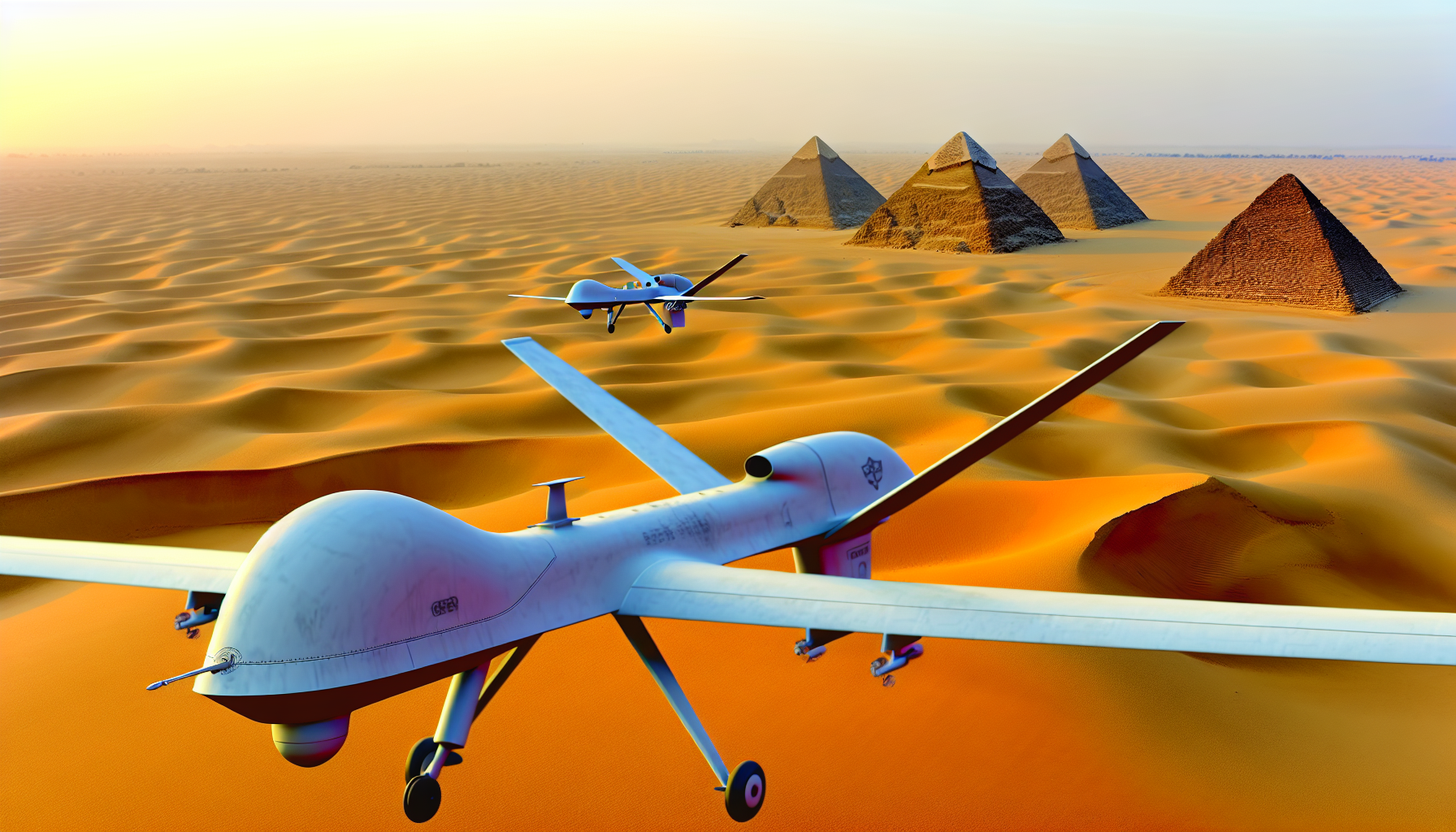
Egypt’s Strategic Leap: The Acquisition of WJ-700 Drones
In June 2025, the Egyptian Ministry of Defence made headlines with a notable contract worth approximately $400 million to procure 10 WJ-700 unmanned combat aerial vehicles (UCAVs) from China. This significant deal not only marks a substantial enhancement of Egypt’s aerial warfare capabilities but also positions the country as the second foreign operator of the WJ-700, following Algeria. The acquisition is detailed in various defence reports from the Arab world and China, illustrating a strategic shift toward cutting-edge, jet-powered platforms capable of executing mission sets beyond the reach of existing turboprop systems.
Deepening Ties with China
This contract emerges against a backdrop of strengthening defence relations between Cairo and Beijing. Earlier in 2025, Egypt successfully integrated the Chinese HQ-9B long-range air defence system into its national defence architecture. Additionally, the “Eagles of Civilisation 2025” joint air exercises in April showcased the operational synergy between Egyptian pilots and personnel from the Chinese People’s Liberation Army Air Force. The WJ-700 is viewed as a critical component within this modernisation effort, offering high-altitude precision strike capabilities in increasingly contested environments.
Technical Specifications and Performance
The WJ-700, also known as “Al-Saqr” or “The Falcon,” is developed by the China Aerospace Science and Industry Corporation (CASIC) HIWING Academy. Unlike the more familiar Wing Loong series that Egypt has utilized since 2018, the WJ-700 features turbojet propulsion, elevating its performance profile from basic loitering capabilities to rapid response and standoff strike potential. Performance specifications indicate that it can achieve attack speeds of up to 700 kilometres per hour, significantly outpacing the Wing Loong II, which has a maximum speed of about 370 kilometres per hour. Such enhancements allow for quicker operational responses, crucial when time-sensitive intelligence demands rapid action, particularly in remote border areas.
Enhanced Survivability and Range
One of the standout features of the WJ-700 is its survivability. Operating at a service ceiling of 15,000 meters (approximately 50,000 feet), the drone stays beyond the effective reach of most man-portable air defence systems (MANPADS) and many short-range surface-to-air missile systems. This altitude grants the WJ-700 a broader field of view and increases its operational safety compared to lower-altitude Medium-Altitude Long-Endurance (MALE) systems, thus allowing for more effective mission execution.
Advanced Weaponry Breakthrough
The WJ-700’s weapons arsenal signifies a leap in Egypt’s operational capabilities. With a payload capacity of up to 800 kilograms distributed across four hardpoints, it supports advanced munitions tailored for penetrating or suppressing sophisticated enemy defences. The CM-102 anti-radiation missile, essential for Suppression of Enemy Air Defences (SEAD), enables the drone to locate and neutralize enemy radar systems, paving the way for manned fighter jets or other strike units to operate safely.
A further addition to its capabilities is the C-705KD anti-ship missile, which allows for standoff engagements against maritime targets or fortified land structures. This represents a shift in Egypt’s naval and border security strategy, focusing on neutralization threats before approaching the enemy’s defensive systems.
Integrating WJ-700 into Existing Forces
Rather than replacing existing fleets, the WJ-700 is set to complement the Wing Loong I and II aircraft, creating a “high-low” mix within the Egyptian Air Force. The Wing Loong series, while efficient in long-endurance surveillance, operates at lower speeds and altitudes, making them vulnerable in high-threat scenarios. The WJ-700’s agility and firepower cater to operations where rapid response and air defence suppression are critical, thereby allowing for a more strategic allocation of military resources.
Financial Considerations and Future Prospects
The acquisition cost of about $400 million for just 10 units highlights the advanced nature of the WJ-700. With a price tag of approximately $40 million per system, this investment aligns the drone closer to manned light-attack aircraft or high-end models like the American MQ-9 Reaper. This cost encompasses ground control stations, satellite communication links, initial training, and spare parts, ensuring Egypt and its military personnel are well-equipped for operational readiness.
Domestic Production and Strategic Diversification
As Egypt’s reliance on Chinese unmanned systems grows, the country seeks to diversify its supplier base in light of previous negotiations with other nations. Although Turkey had agreed to supply combat drones as part of improved diplomatic relations, tangible outcomes have yet to materialize. This has led Egypt to pursue domestic co-production strategies for its lower-tier drone needs.
During the EDEX 2025 exhibition, the Arab Organisation for Industrialisation (AOI) announced partnerships aimed at producing the “Hamza-2,” a drone model influenced by the ASN-209, and a memorandum of understanding with Turkish firm Havelsan for the “Hamza-1.” These initiatives illustrate Egypt’s commitment to building smaller, indigenous systems while investing in high-end imports like the WJ-700.
Regional Implications and Technological Independence
The deployment of the WJ-700 in North Africa reflects a significant shift in the regional balance of unmanned aerial power. Following Algeria’s acquisition of WJ-700 units, Egypt’s larger order enhances its strike doctrine, providing deterrence against other regional entities equipped with advanced air defences.
More broadly, this shift to Chinese technology signifies Egypt’s move toward technical independence from traditional Western suppliers. The Egyptian Air Force’s previous reliance on constrained versions of American F-16 fighters is transforming, as the integration of Chinese air defence systems and fighter jets allows for more robust operational capabilities.
Conclusion
As Egyptian personnel begin their training with the WJ-700, the focus will likely be on integrating these advanced systems into existing command and control frameworks. By successfully incorporating the WJ-700 alongside its current fleet, Egypt may soon possess one of the most sophisticated drone inventories in the region, capable of meeting diverse operational demands from border surveillance to high-intensity strike warfare.