


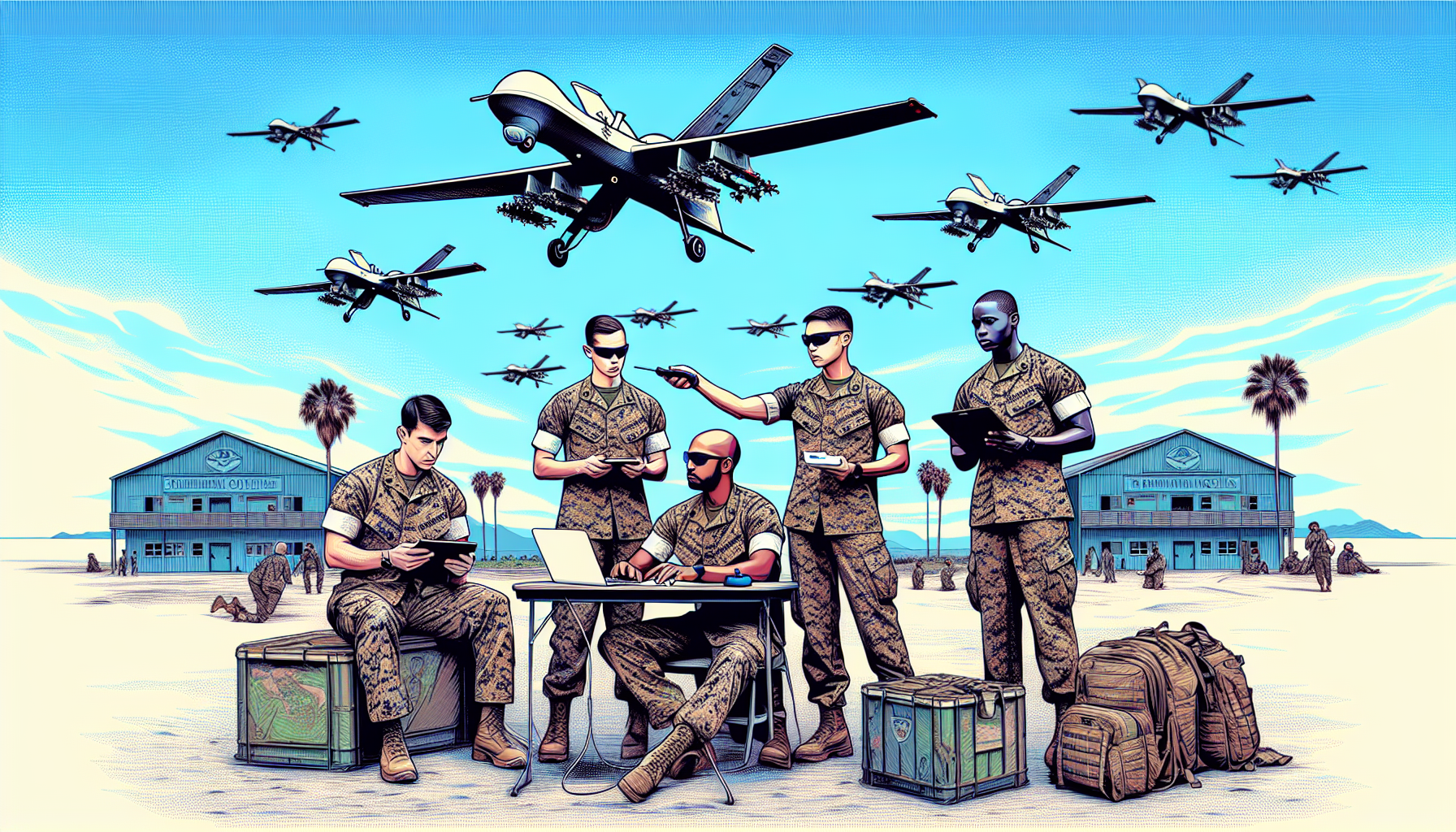
Training the Future: West Coast Marines Master Attack Drones
The rapid evolution of warfare has necessitated a shift in training methodologies within military organizations. Among these changes, the West Coast Marines have embarked on an innovative 15-day crash course designed to immerse personnel in the operation of attack drones. This intensive program aligns with a wider initiative to enhance drone readiness across the Marine Corps, reflecting the growing importance of unmanned systems in modern military operations.
From Simulators to Real-World Flights
The training course begins with several days devoted to simulators, vital for developing core flying skills. These simulators offer a safe environment where Marines can learn the intricacies of aerial navigation without the immediate risks associated with real-world flying. After gaining confidence in the simulated environment, trainees transition to cheap and expendable off-the-shelf drones, which serve as a practical stepping stone before moving on to more sophisticated systems.
One of the advanced systems introduced is the Neros Archer drone, which recently received a significant $17 million contract to supply the Marine Corps with around 8,000 units. This progression from basic to complex systems not only enhances technical skills but also prepares Marines for diverse operational scenarios. 1st Lt. Braeden McClain, the infantry officer overseeing the course, emphasizes the importance of this method, stating, “The simulators allow them to develop the core skills that we can then transition to our smaller drone for them to refine.”
Focus on Team Dynamics and Safety
Beyond technical skills, the training also prioritizes mission execution and safety. Throughout the course, Marines are placed in various roles—pilot, team leader, communications support, and payload specialist. This dynamic environment fosters collaboration and emphasizes the importance of teamwork in a combat setting. As participants practice aerial navigation and payload preparation, they also engage in team-based drills that reflect crucial lessons learned from contemporary conflicts, like the ongoing war in Ukraine.
In these exercises, Marines fly drones through makeshift PVC gates, honing their flight dexterity while navigating to specific grid coordinates for striking targets. This team-based approach not only sharpens individual skills but also reinforces the necessity of cohesive action within a squad.
Understanding the Challenges
The challenges inherent in navigating and operating drones have not gone unnoticed. McClain acknowledges that most participants initially struggle with fundamental concepts, particularly aerial navigation, as many Marines are not familiar with flying. However, the program addresses these issues head-on, helped significantly by instructors who have backgrounds in drone piloting outside of military training.
The course aims to graduate 500 qualified drone operators annually, providing the Marine Corps with a robust talent pool skilled in the latest drone technologies. Importantly, these newly certified operators are not designated to specific military occupational specialties tied to larger drone platforms; instead, they represent a broad initiative to embed drone training across all levels of the Marine Corps.
Rapid Adaptation to Battlefield Lessons
The urgency behind this training initiative reflects a broader Pentagon strategy for rapid adaptation to new warfare tactics. The conflict in Ukraine has underscored the need for flexibility in drone operations, highlighting how quickly drone warfare is evolving. Defense Secretary Pete Hegseth has issued directives to modernize drone acquisition, aiming to enrich U.S. military capabilities with over $1 billion worth of attack drones set to roll out by 2028.
Lt. Gen. Benjamin Watson, overseeing the Marine Corps’ Training and Education Command, underscores the necessity for rapid fielding of drones. “We’ve got to field drones at scale in order to be able to pressurize our training, really to work through some of the real hard problems,” he stated at a recent symposium. This push for immediate implementation marks a significant departure from traditional military protocols that often lag in technology adoption.
The Broader Push for Drone Integration
Last year, the Marine Corps authorized a wider training initiative, aspiring to add 10,000 drones over the upcoming year as part of its comprehensive modernization plan. Operating within this framework, the 1st Marine Division’s training program serves as a key component of the Marine Corps’ lead organization for drone operations, the Attack Drone Team, based in Quantico, Virginia. This team is pivotal in developing standardized training protocols, ensuring a uniform approach to drone operations across the service.
Maj. Alejandro Tavizon, commander of the headquarters company at the Weapons Training Battalion, emphasizes the goal of ensuring Marines are not only proficient in drone operation but also capable of seamless team integration. The focus on adaptable, team-based drone use, informed by real-time lessons from ongoing conflicts, requires the training course to evolve continuously—an approach not routinely seen within traditional military training environments.
In the fast-paced world of drone warfare, the ability to rapidly integrate new tactics and technologies is essential. With constant updates to training based on battlefield developments, flexibility has become the operative word. McClain captures this sentiment, noting, “At this rate, we see a significant advancement every three to six months. Flexibility is definitely the name of the game.” As the West Coast Marines sharpen their skills, they embody the future of military operations, where technology and teamwork are indispensable.