


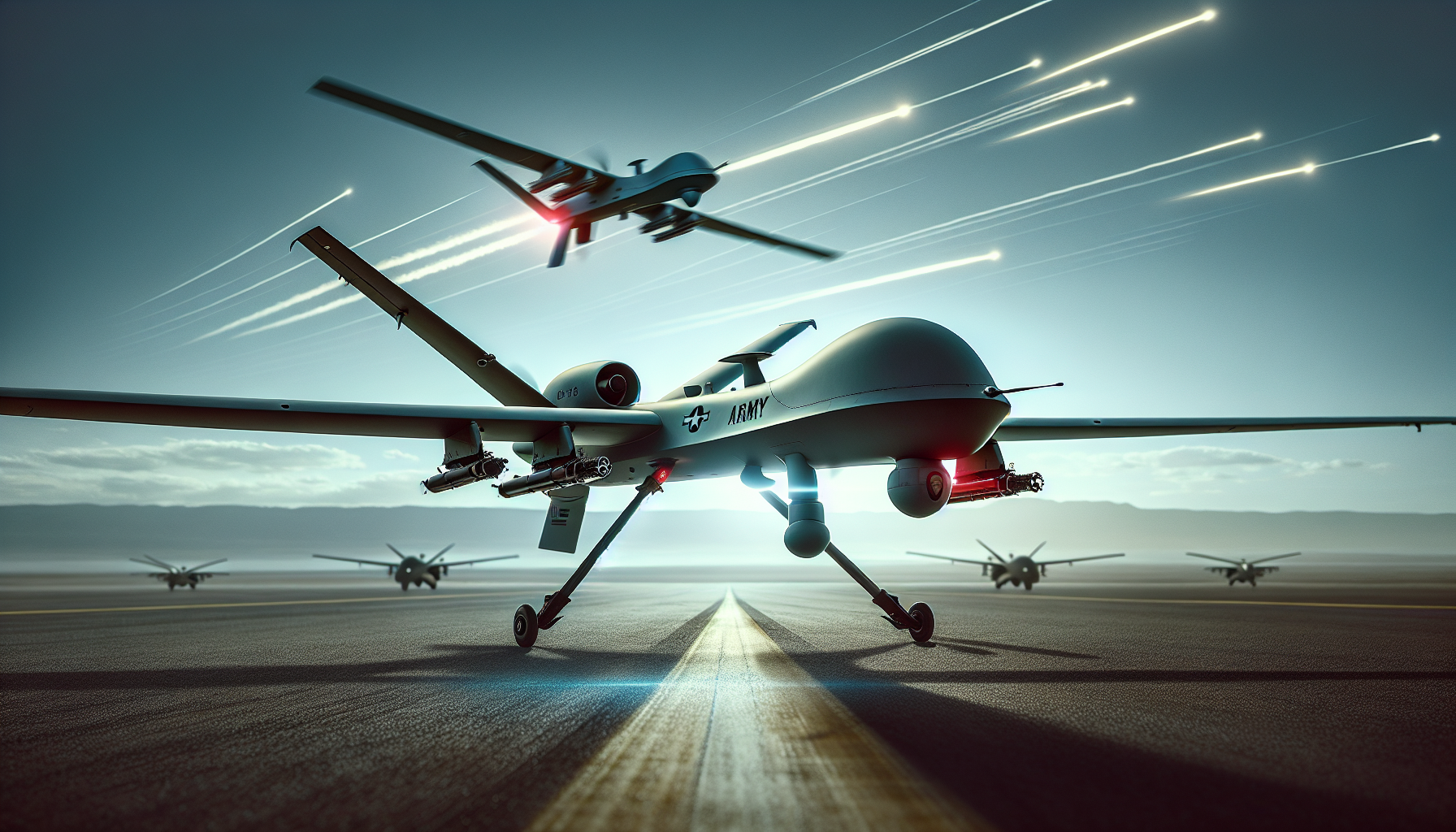
The Drone Dominance Program: Challenges and Potential at Fort Irwin
A Desert Testing Ground
Nestled in the northeast rim of California’s Mojave Desert, the Fort Irwin National Training Center is an extensive arena for military exercises. Although its scrubby landscape sharply contrasts with the fertile plains of eastern Ukraine, the focus on militarized drones has created a shared narrative between these disparate locations. As the U.S. Army amplifies its reliance on uncrewed aircraft systems (UAS), the relevance of innovative drone technologies is becoming undeniable.
The Drone Dominance Program
The Pentagon’s six-month-old Drone Dominance Program aims to deploy over 340,000 small UAS by the close of next year. This ambitious initiative underscores a transformative leap in modern warfare as U.S. Army units endeavor to integrate these unmanned systems into their operations. The excitement around these advancements is palpable, but so are the challenges that lie ahead.
Recent Exercises: Unveiling Gaps
During recent training exercises at Fort Irwin, the Army encountered noticeable gaps in drone readiness. The September drills were particularly telling, revealing hurdles in power generation, battery supply, and interference that participants struggled to navigate. These challenges pointed to the pressing need to enhance logistical preparations for the hundreds—if not thousands—of drones on the horizon.
Racing Against Time
Regiment-sized units, which typically possess only a handful of UAS, are now racing against time to ready themselves for a future where drone swarms could dominate the battlefield. As part of their ongoing training, these units are being called upon to adapt quickly to new operational realities. However, transitioning to an era of mass drone deployment is no small feat, as evidenced by recent brigade-size training events.
A Close Look at the 82nd Airborne Division
A pioneering attempt by elements of the 82nd Airborne Division in September illuminated the complexities of integrating drones into large-scale training exercises. While the objective was to harness the power of swarming tactics, limitations quickly became apparent. Lt. Col. Mat Scott, commander of the division’s 504th Parachute Infantry Regiment, articulated the disappointment: “I wanted to swarm, but we only got four [UAS] up at any point in time, which is a far cry from the 42 that I wanted up at once.”
Notable Successes, Despite Shortcomings
While the exercise fell short of its drone swarm aspirations, even the small number of UAS utilized showed remarkable potential. A mere cohort of 18 paratroopers—consisting of 11 UAS operators and seven electronic warfare specialists—was responsible for identifying targets correlating to 44% of the 2,692 mortar rounds fired over eight days of simulated combat. This effort led to 241 confirmed enemy casualties and the disabling of key armored vehicles.
Training Insights: What Went Wrong
Despite these victories, the focus among unit leaders remains on areas needing improvement. Lt. Col. Scott is particularly critical of the regiment’s ability to capitalize on drone-detected targets. Out of the seven days of training, the unit failed to respond to 399 identified threats, including enemy tanks and command-and-control centers. The overwhelming number of targets proved too much for the soldiers to manage within the confines of the exercise.
Overcoming Cognitive and Logistical Challenges
Scott acknowledged that the volume of targets identified was simply beyond their processing capability. “We just couldn’t shoot because the fires apparatus or our own personal human bandwidth—cognitive bandwidth—wasn’t there to process it and get it done,” he explained. The cognitive load on the commanders increased significantly, further complicating an already challenging operational environment.
Technical Hurdles: A Focus on Power Supply
Among the most pressing obstacles encountered during the training was a shortfall in battery supply. The regiment assumed they would have enough double-charging batteries on hand, but the reality proved otherwise; drones typically exhausted their batteries within 28-29 minutes of flight time, requiring 2.5 hours to recharge. This stark logistical reality prompted significant rethinking about supply chain management for upcoming exercises.
Power Generation Issues
Power generation for drone chargers posed added challenges. Paratroopers often arrived with minimal gear, having to rely on logistics vehicles for additional support, which arrived inconsistently. When these vehicles reached their designated spots, technical reliability issues with power generators arose, further complicating efforts to maximize operational drone deployments.
Radio Frequency Interference
The training environment was further complicated by radio frequency (RF) interference from ground control stations. Effective communication is vital for operational success, and the overlap of signals necessitated a physical spacing of more than 35 feet to avoid jamming. This further limited the number of drones that could be safely operated at any given time.
A Recipe for Improvement
Despite the myriad of challenges faced during the recent exercises, the lessons learned at Fort Irwin are paving the way for future enhancements in drone warfare tactics. The combination of battery limitations, logistical inefficiencies, and cognitive overload has created a compelling case for adaptation and improvement in training methods. As the Army looks ahead to a future dominated by drone technologies, the experiences of troops at Fort Irwin offer valuable insights into what works and what needs sharpening as they push the boundaries of modern military operations.