


Exploring the Complexities of Drone Warfare
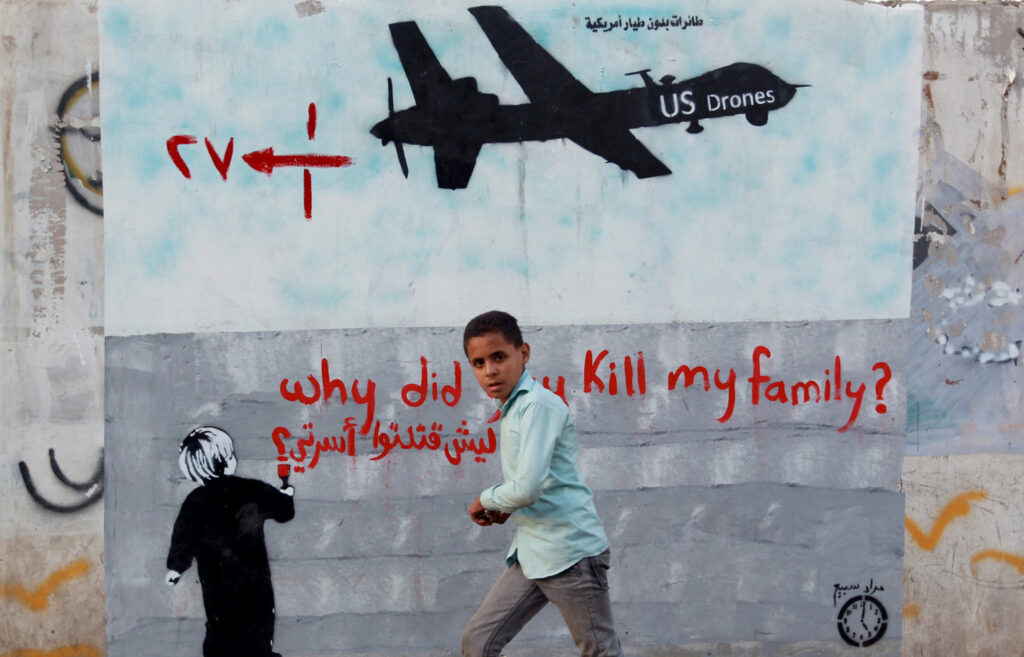
Mural in Sanaa, Yemen: A Visual Representation of the Conflict

In this poignant mural, a Yemeni boy stands beside a stark reminder of the drone strikes that have caused civilian casualties, raising vital questions about the ethics of drone warfare.
A Turning Point in Drone Warfare
The ethical landscape of warfare is shifting dramatically, as evidenced by key events that highlight this change. On June 20, 2019, Iran shot down a U.S. drone over the Persian Gulf, accusing it of infringing upon its airspace. The U.S. countered, claiming it occurred in international waters, showcasing how drone warfare complicates traditional notions of sovereignty and engagement. This incident is emblematic of a larger trend: the use of drones has escalated over the years, blurring the lines of combat and increasing the stakes of international relations.
The Rise of Drones
Drones initially emerged as tools of surveillance but rapidly evolved into instruments of warfare. Though Iran first weaponized drones in the mid-1980s, the United States has become the leading consumer of drone technology. After the tragic events of September 11, 2001, the U.S. adopted drones fundamentally, significantly increasing the frequency of drone strikes. Notably, during President Barack Obama’s tenure, drone strikes surged to six times the level seen during George W. Bush’s administration, marking the era as the “drone presidency.” Under President Donald Trump, the pace of strikes escalated further, averaging a strike every 1.25 days.
Shifting Paradigms of Warfare
Traditionally, warfare involved organized armies facing off in designated battle areas, adhering to international laws such as the Geneva Conventions. However, the rise of drones introduces a new kind of warfare—one that often takes place outside of formal conflict zones and involves actors who do not wear uniforms. This new landscape raises pressing ethical questions about the conduct of war, particularly concerning civilian casualties and accountability.
Attempts to Address Ethical Concerns
In response to rising concerns about civilian casualties from drone strikes, President Obama took steps to refine drone operational guidelines. His administration issued guidance aimed at minimizing civilian harm, emphasizing the importance of adhering to principles rooted in Just War Theory. These principles—humanity, necessity, proportionality, and distinction—serve as a guiding framework for evaluating the morality of military actions.
Humanity and Civilian Impact
The principle of humanity focuses on minimizing unnecessary harm to non-combatants. Advocates for drone use argue that drones allow for precise targeting, potentially saving civilian lives when compared to conventional warfare strategies that may lead to widespread devastation. General T. Michael Moseley of the U.S. Air Force endorsed this view, advocating for drones as “true hunter-killers.” However, the reality remains complex. Estimates vary widely regarding civilian casualties from drone strikes, with reports indicating that while thousands of terrorists have been killed, civilian deaths are frequently underreported.
The Challenge of Distinction
One of the most significant hurdles in the ethical assessment of drone warfare is the principle of distinction, which requires clear identification of military targets. In the context of the war on terror, distinguishing between combatants and civilians becomes increasingly difficult. Initiatives such as “signature strikes” attempt to identify targets based on behavioral patterns rather than explicit identification, leading to potentially tragic misjudgments.
Necessity and Proportionality in Context
The principle of necessity mandates that targets possess a clear military objective. Drones offer inherent advantages in accessing difficult terrains and conducting operations with minimal risk to military personnel. Conversely, the principle of proportionality dictates that the force used in warfare should be commensurate with the threat posed. Events like the Iranian drone incident highlight the precarious balance of military response, where escalated actions can lead to disproportionate harm.
Legal and Moral Implications
International humanitarian law imposes restrictions on military action, particularly concerning armed drone flights in non-conflict zones without a host nation’s consent. Critics argue that U.S. drone strikes often sidestep these regulations, effectively creating a global battlefield under the guise of counter-terrorism. The debate extends beyond legality to moral implications, as the U.S. positions its actions within a self-defense framework that some scholars argue strays from traditional interpretations of imminent threat.
The Psychological Toll on Drone Operators
The ramifications of drone warfare extend beyond distant strikes. Drone operators, required to confirm kills and witness the aftermath of their actions, often experience intense psychological stress. Reports indicate a significant incidence of post-traumatic stress disorder (PTSD) among these pilots, underscoring the human cost of operating from afar.
A Broader Perspective on Warfare
The implications of drone warfare extend into geopolitical dynamics. Recent developments, including drone attacks on critical infrastructure, indicate a potential shift towards integrating drone technology into traditional state-to-state conflict. As the scope and legality of drone deployment continue to generate debate, it is increasingly apparent that these developments challenge the optimistic views of controlling warfare that emerged in the twentieth century.
Ultimately, exploring these issues illuminates the complex ethical, legal, and psychological landscape of modern warfare. The push and pull of drone technology in combat reflect a profound transformation in military engagement, compelling us to rethink the conduct, ethics, and governance of warfare in the 21st century.