


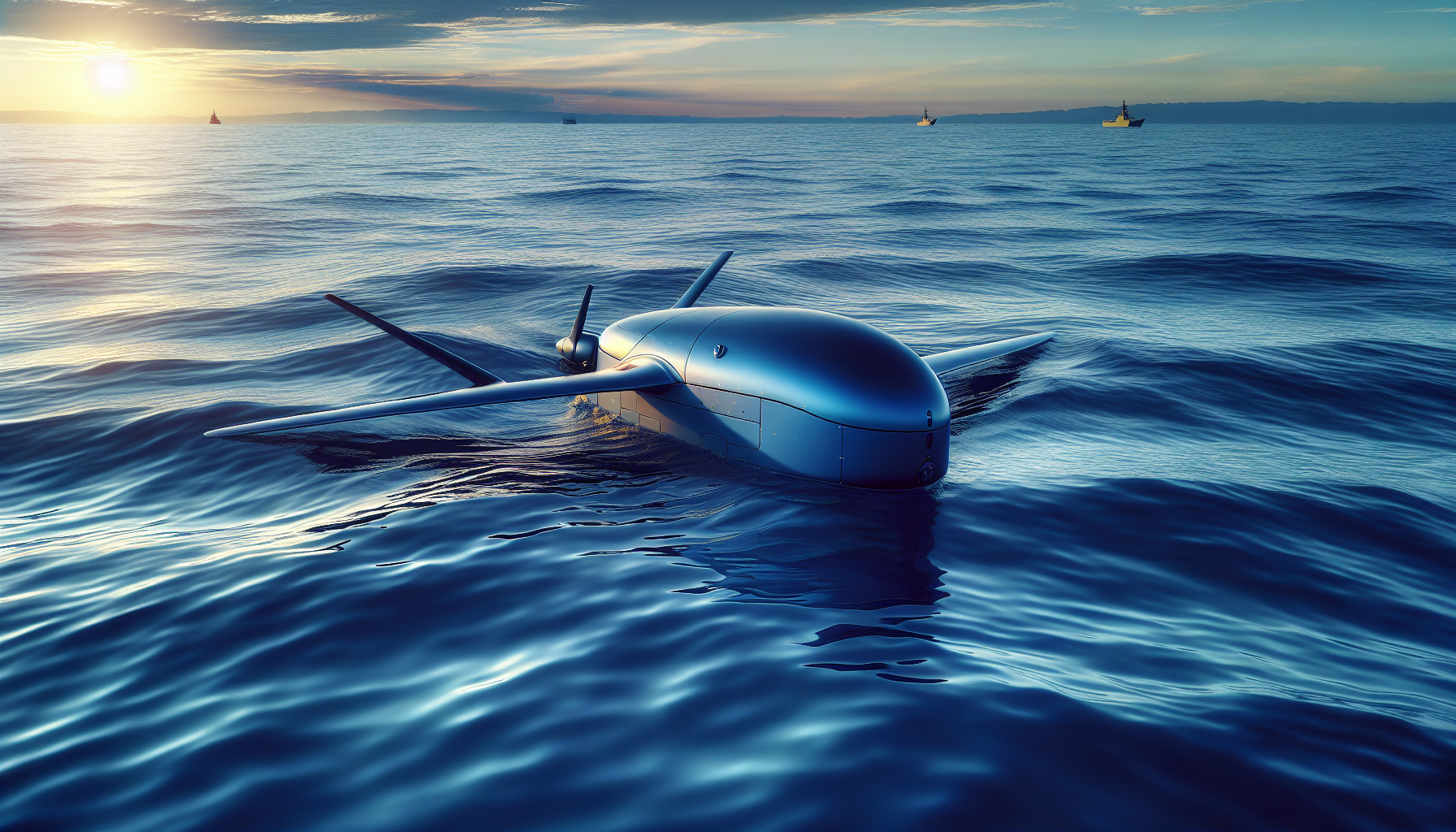
A French maritime robotics and navigation systems company has just secured two new contracts for its DriX H-9 autonomous surface drone, designed to support both France and an undisclosed allied navy. These developments highlight the growing importance of autonomous systems in modern naval operations, particularly in response to the increasing array of threats within maritime domains.
On January 7, 2026, Exail Technologies, based in Paris, confirmed these significant contracts for its DriX H-9 autonomous surface vessel (USV). The company emphasized that “these innovations respond to the multiplication of threats in the maritime domain,” underlining the pressing need for advanced technology in naval defense.
Introducing the DriX H-9
The DriX H-9 is a long-range variant of Exail’s DriX unmanned surface drone family, specifically designed for extended missions at sea with minimal human intervention. Measuring 29.5 feet (nine meters) in length and displacing 2.1 tons, the DriX H-9 is engineered to operate autonomously for up to 20 days.
With a reach of approximately 2,000 nautical miles (2,301 miles), the drone is ideally suited for tasks like prolonged surveillance, maritime monitoring, and hydrographic surveying. Its impressive fuel capacity of 550 liters allows it to maintain a cruising speed of up to 13 knots while keeping low acoustic and radar signatures, a crucial feature for stealth operations.
Navies Begin Utilization
The DriX H-9’s capabilities extend beyond mere surveillance. Unlike its smaller counterpart, the DriX H-8, the H-9 is equipped for remotely operated towed vehicle (ROTV) deployment and towing capabilities. Furthermore, it can efficiently operate multibeam echo sounders (MBES) at depths reaching 9,842 feet (3,000 meters), thereby enhancing its versatility in underwater missions.
The vessel’s design emphasizes ease of deployment and logistics, with the entire platform being transportable in a single 40-foot container. This practicality is complemented by advanced operational capabilities. Under the first of Exail’s two recent contracts, the H-9 will be configured for counter-unmanned aerial system (CUAS) missions, integrating third-party sensors to detect, track, and neutralize hostile aerial drones.
While counter-drone systems are common on land, adapting this technology for autonomous maritime platforms is a game-changer for offshore protection, allowing naval forces to enhance their operational footprint far beyond coastal boundaries.
Maritime Defense Autonomy
By equipping surface drones like the DriX H-9 with CUAS capabilities, naval forces can establish a robust defensive perimeter against aerial threats. Exail emphasizes that the drone’s autonomy, carrying capacity, and modularity enable quick integration of various systems for a broad array of missions, including surveillance, security, hydrography, and infrastructure protection.
The second order for the DriX H-9 comes from the Hydrographic and Oceanographic Service (SHOM) of the French Navy, marking the agency’s second acquisition of a DriX system. This reinforces the platform’s growing reputation for accurate seabed mapping and efficient maritime data collection.
In this capacity, the DriX H-9 is expected to accelerate survey cycles, expand coverage areas, and deliver reliable data more promptly, all of which are essential for safe maritime navigation, port management, and maritime space planning.
With three orders for the DriX H-9 secured in just a few months, Exail Technologies is clearly demonstrating the technological maturity and operational relevance of its range of autonomous drones. The company projects finalization of additional surface drone contracts throughout 2026, signaling a promising future for both Exail and the maritime defense community.