


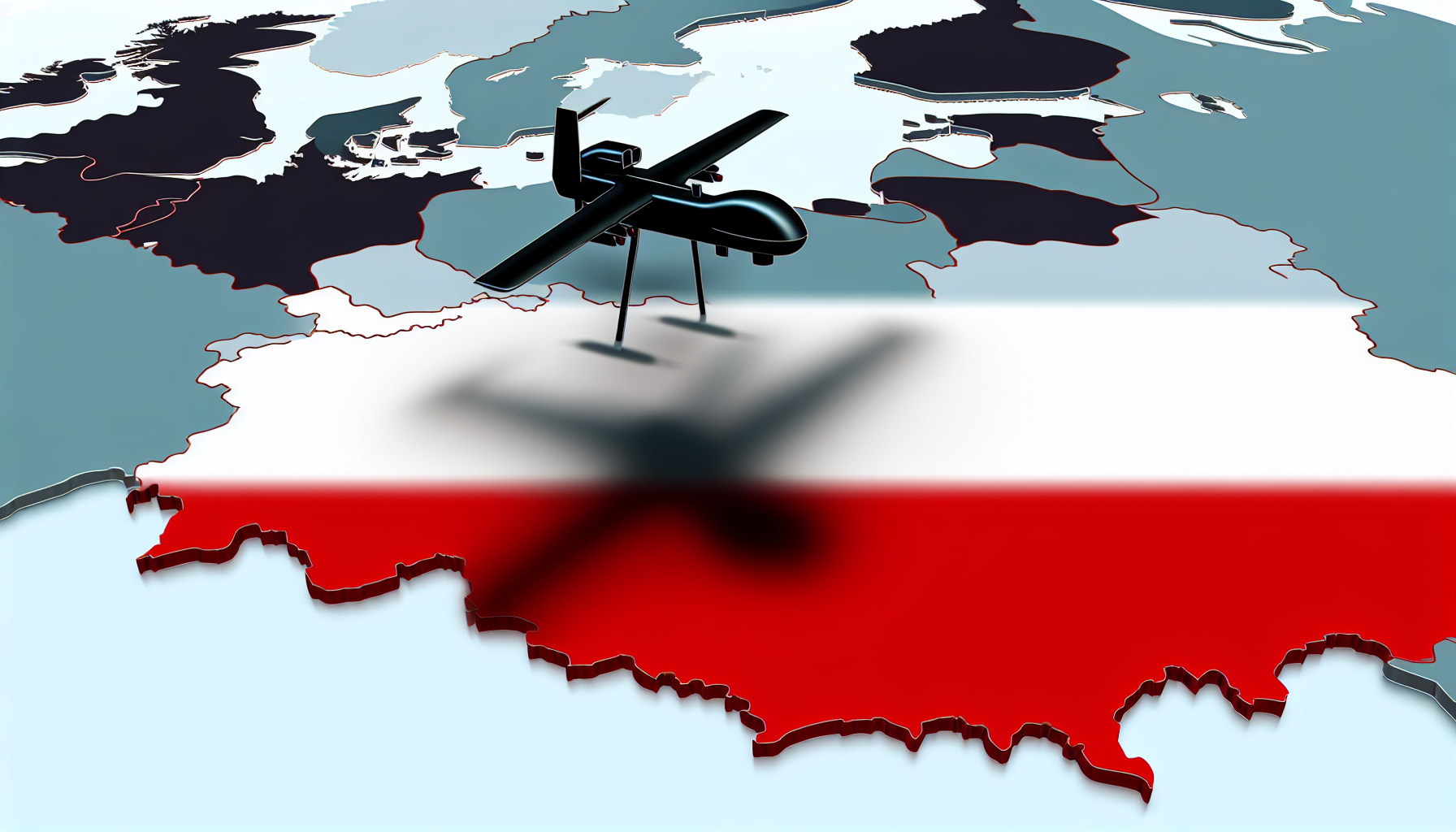
Poland and Romania’s Response to Drone Threats
Poland and Romania are stepping up their defenses against an increasingly concerning threat: Russian drone incursions. Following recent violations of NATO airspace, these countries are rolling out a new weapons system designed to counteract the vulnerabilities exposed by such incidents. This action reflects a broader push within NATO to secure its eastern flank as tensions continue to rise in the region.
The American Merops System
At the heart of this defense initiative is the Merops system, an American technology that proves both innovative and compact. Small enough to fit in the back of a midsized pickup truck, Merops can identify hostile drones and close in on them effectively. Utilizing artificial intelligence, this system has the capability to navigate in environments where satellite and electronic communications may be disrupted.
Deploying Across the Eastern Flank
In addition to its deployment in Poland and Romania, Denmark has expressed interest in integrating Merops into its defense strategy. As NATO military officials suggest, the overarching aim is to transform the border with Russia into a heavily fortified zone. This initiative seeks to ensure that Moscow’s military tactics remain constrained, fostering a mindset of deterrence from Norway in the north to Turkey in the south.
Recent Incursions Highlighting Vulnerabilities
The necessity for advanced drone detection and interception systems has never been clearer. In early September, around 20 Russian drones entered Polish airspace, prompting rapid responses from multimillion-dollar fighter jets, illustrating a stark disparity in costs and efficiency when countering such inexpensive threats. Romania, too, faced drone incursions, while airports across major European cities, including Copenhagen, Munich, Berlin, and Brussels, found themselves temporarily closed due to drone activity.
A New Era of Warfare
The upsurge in drone activity across Europe is not merely a nuisance; it reflects a significant shift in modern warfare. NATO officials recognize that the stakes are high—a prolonged drone conflict, much like the ongoing war in Ukraine, could quickly deplete Western military resources and available munitions.
Col. Mark McLellan, NATO’s assistant chief of staff for operations, emphasized the importance of systems like Merops in providing high-accuracy detection of drones. He highlighted that using Merops is far more cost-effective than deploying advanced fighter jets, such as the F-35, to take down drones that cost considerably less.
The Technological Challenge
Drones operate at low altitudes and slower speeds, making them challenging to detect with traditional radar systems optimized for high-speed threats. Merops improves situational awareness for defense forces by filling those critical gaps. As explained by McLellan, the system can launch its own drones against hostile targets, or relay vital information to ground and air forces to ensure an effective response.
Decision-Making and Threat Assessment
The Merops system also extends an essential window for decision-making in the heat of the moment. Brig. Gen. Thomas Lowin noted that the technology allows commanders a certain amount of time to assess an incoming threat before choosing whether to engage. This capability is crucial in protecting critical assets like airports and military forces amid a fast-evolving battlefield.
Broader Strategic Implications
As NATO begins deploying Merops along its borders with Poland and Romania, it aims to build a resilient defense architecture. The increasing attention on such technologies comes in light of historical conflicts messing with perceptions of security in Europe. Notably, former Google CEO Eric Schmidt’s investment in Merops underscores the intersection of technology and defense.
A Response to Evolving Threats
With the evolving nature of drone warfare, the Merops solution exemplifies how military strategies are adapting. Each new type of drone demands a tailored response. As Brig. Gen. Zacarias Hernandez stated, identifying emerging threats quickly is critical, necessitating rapid production cycles to bring solutions from development to combat readiness in mere weeks.
Broader European Defense Initiatives
Resonating with NATO’s response, this strategic shift is also mirrored across the European Union, which is collaborating to establish a “drone wall” along its eastern borders. U.S. military leaders advocate for an integrated and adaptable defense network, bringing together sensors and command-and-control systems designed to maximize efficiency and effectiveness in confronting a common adversary.
Facing a Prominent Adversary
Russia’s substantial military presence and manpower along its borders present a notable challenge for NATO. The alliance recognizes the need not only for technological advancements but also for a coordinated defense strategy to neutralize Russia’s advantage. Merops represents a pivotal step in this ongoing effort, addressing both immediate threats and long-term security concerns for member states.
Technological Arms Race
Both NATO and Russia are caught in an arms race fueled by the actionable lessons of the ongoing conflict in Ukraine. Recent remarks by President Vladimir Putin allude to Russia’s increasing capability to innovate quickly in response to battlefield challenges, reflecting a broader trend of rapid technological adaptation.
Conclusion
The strategic deployment of the Merops system by Poland, Romania, and their NATO allies signifies a critical juncture in the ongoing evolution of military strategy in Europe. As these nations work to bolster their defenses against an ever-adapting threat, the focus will continue to be on technological advancements, rapid adaptability, and collaborative defense efforts across the alliance.