


The Reemergence of Urban Warfare Training: A Deep Dive into Germany’s Recent Military Exercises
The Setting of Urban Warfare in Berlin
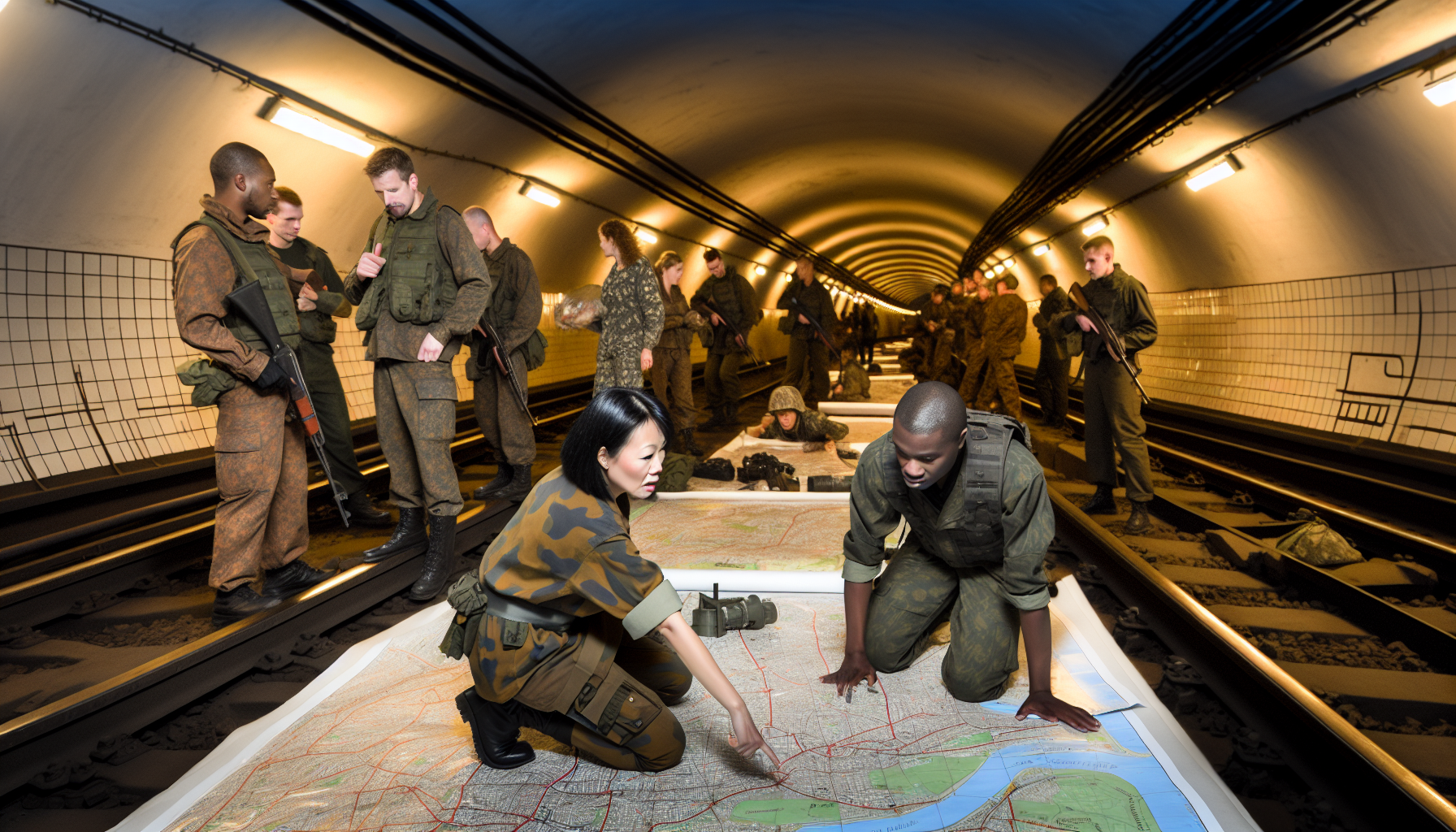
Berlin’s underground subway system was the focal point of a unique military operation recently conducted by the German Army, specifically at the Jungfernheide station. Picture this: 30 soldiers abruptly storming down a staircase, ready to engage in combat, while machine-gunners set up their weapons on the platform. As they jump onto the train tracks, chaos takes over with smoke filling the tunnel and the deafening noise of automatic gunfire. This stark setting emphasizes the current reality for military forces as they adapt to new threats posed by urban environments.
Historical Context: Cold War Echoes
These military drills are reminiscent of the Cold War, when the divided city of Berlin faced potential invasions from the Warsaw Pact. Soldiers conducted exercises to prepare for urban warfare scenarios that could entail defending against enemy forces within the city. The backdrop of these modern exercises continues to reflect concerns around a potential conflict with Russia, a stark reminder that security dynamics on the European continent are evolving.
Insights on Recent Exercises: Operation Bollwerk Bärlin
Between 1:00 a.m. and 4:00 a.m. over three consecutive nights, around 250 soldiers from the German Army’s Guard Battalion engaged in maneuvers that often included combat scenarios involving hostile elements on subway trains. Dubbed Operation Bollwerk Bärlin III, these exercises focused on preparing soldiers to combat sabotage within urban settings while ensuring the safety of the local population—Berlin’s estimated 3.9 million residents.
Training Scenarios: Realistic and Rigorous
The training wasn’t limited to the subway. It also extended to a former chemical plant and a NATO training area that was repurposed for police usage. Soldiers were instructed to neutralize threats while securing and evacuating the wounded. The realism of the operation was amplified by utilizing active rail cars to simulate real-life situations of chaos and urgency that might arise in an attack scenario.
The Role of the Guard Battalion
The Guard Battalion, often recognized for its ceremonial roles, has a combat function as part of the Joint Service Support Command of the German Armed Forces. During the exercise, soldiers transitioned from traditional ceremonial tools to modern weaponry–the Heckler & Koch G36 assault rifle, replacing their historical Karabiner 98k rifles. This shift prioritizes adaptability and effectiveness in contemporary combat scenarios.
The Importance of Realistic Terrain
As Lt. Col. Maik Teichgräber noted in an interview, training in Berlin is particularly essential due to its status as a central area for government facilities. The drills focused on preparing for unpredictable contingencies, incorporating everything from confined spaces to poor visibility—elements that will shape their operational readiness.
Urban Warfare: A Global Perspective
Germany is not alone in adapting its military training for urban warfare. Similar exercises have been observed worldwide. For instance, Taiwan’s military utilizes its metro system as a tactical advantage during annual exercises. Those situations reinforce the idea that modern conflicts, particularly with urban centers as battlegrounds, require innovative strategies and thorough preparation.
The U.S. Military and Urban Combat Training
There is also a growing recognition within the U.S. military regarding the importance of urban warfare and underground fighting. With cities becoming potential future battlegrounds, military leaders are exploring strategies to navigate the complexities and vulnerabilities of combat in urban ecosystems effectively.
Looking Back: Cold War Lessons
The Cold War era saw NATO forces extensively preparing for urban warfare scenarios in West Berlin, traditionally focusing on unconventional warfare tactics. Fast forward to today, and the lessons learned from historical confrontations are being integrated into training regimens, reflecting a world shaped by both military strategy and the realities of contemporary geopolitical tensions.
The Future of Defense Strategies in Germany
Germany’s recent military maneuvers signify a pivotal shift in defense posture within Europe. Upcoming defense budgets projected to reach €153 billion by 2029 illustrate Germany’s commitment to increasing its military capabilities. This significant investment points towards a transformative approach, one that positions Germany not only as a regional power but as a potentially decisive player within NATO.
Preparing for the Unthinkable
The exercises underscore that the stakes are high. Lt. Col. Teichgräber emphasized preparing for potentially catastrophic scenarios, underscoring the urgency that surrounds these operations. With rising tensions in Eastern Europe, the necessity for military readiness takes on an entirely new meaning.
As global dynamics shift and security landscapes redefine, the preparedness for urban warfare is fast transforming across military organizations. The vigilance displayed today in Berlin reflects a future where nations must continuously adapt, strategizing for unpredictability and maintaining readiness in an increasingly complex world.