


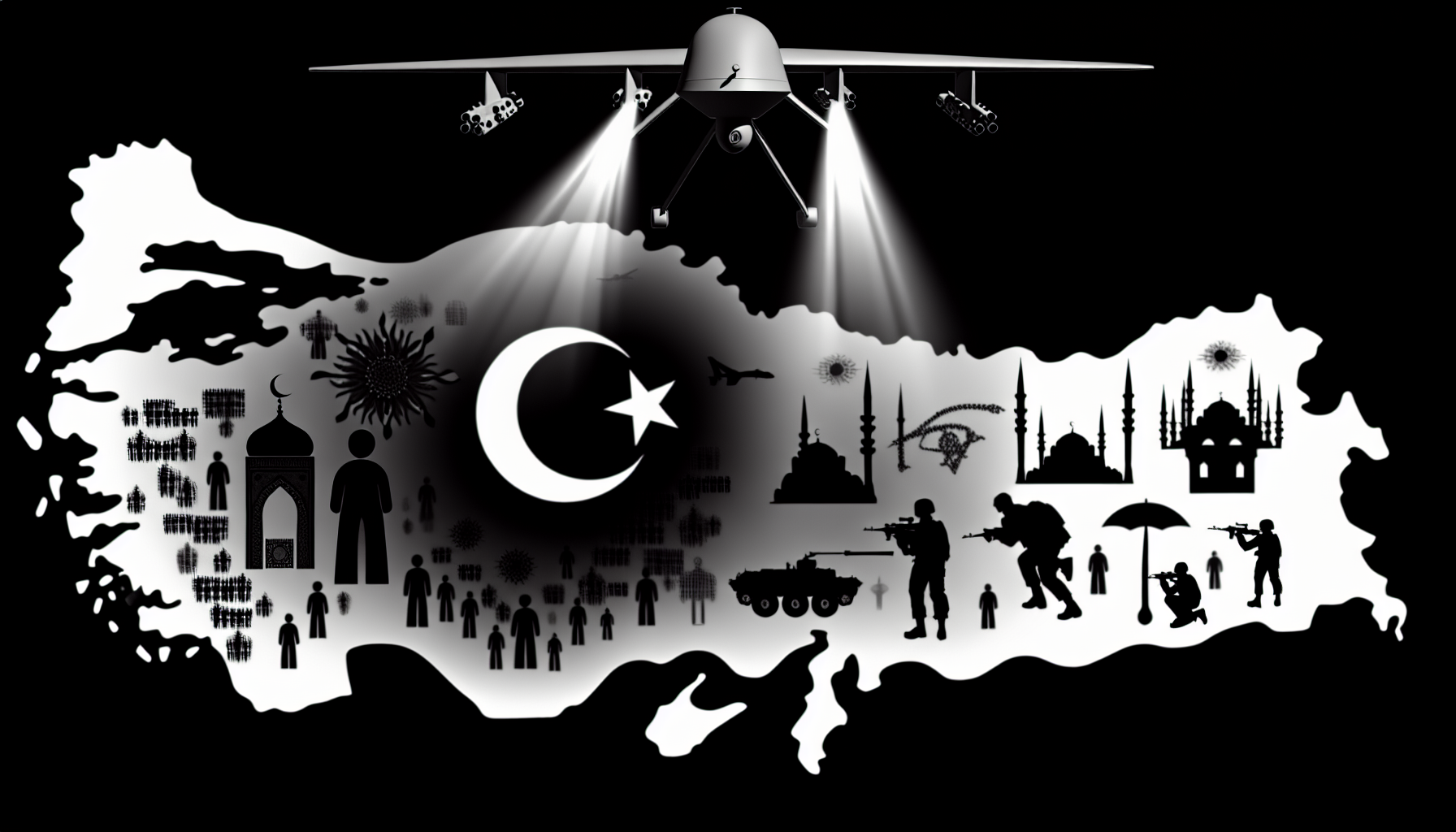
Erdoğan’s Turkey sees contemporary military technology such as drones as facilitators of a grand strategy inspired by Islamism.
This article delves into the complex intersection of drone warfare and political Islam within the framework of contemporary Turkish foreign policy. Central to this exploration is the assertion that Turkey’s burgeoning military-tech complex, exemplified by companies like Baykar, has ushered in a novel form of interventionism across West Asia, North Africa, and the Caucasus. By analyzing Turkey’s drone deployments in Libya, Syria, Nagorno-Karabakh, and beyond, we uncover how unmanned aerial systems (UAS) have evolved into instruments of not only hard power but also ideological propagation aligned with Ankara’s ambitions of neo-Ottomanism and Islamist solidarity. This perspective situates Turkey’s drone diplomacy within a wider geopolitical context where the amalgamation of defense-industrial innovation and political Islam empowers a distinctive, technologically driven assertiveness under Erdoğan’s leadership. Moreover, it interrogates how Turkey’s use of drones blurs the delineation between state security interests and transnational ideological networks, thereby transforming conventional paradigms of regional influence, alliance-making, and sovereignty.
Turkey’s rapid ascent as a drone power has not only transformed its foreign engagements but has also redefined regional military confrontations. Over the past decade, Ankara has successfully developed an indigenous unmanned aviation sector, led predominantly by Baykar’s Bayraktar TB2 combat drones. These unmanned vehicles have emerged as strategic instruments and symbols of national pride, facilitating Turkey’s projection of military power economically and effectively in theaters such as Libya, Syria, and Nagorno-Karabakh. Domestically, the success of Turkey’s drone industry under Erdoğan has been weaved into an ideological narrative that celebrates a resurgent Turkey reclaiming its historical Ottoman dominance and asserting itself within the Muslim world. This intertwining of Islamist ideology and cutting-edge military technology is simultaneously remaking the Middle East and posing challenges to US strategic interests.
Drones as Instruments of Intervention
Turkey’s military UAVs have emerged from their symbolic status to become critical actors on various battlefields. Beginning in the mid-2010s, Bayraktar TB2 drones have been deployed in significant conflict zones, demonstrating their capability to alter the course of warfare. In Libya, for instance, Turkish intervention in 2019-2020 on behalf of the UN-recognized Government of National Accord (GNA) showcased the decisive role played by these drones. By effectively targeting rival Libyan National Army (LNA) artillery and tanks, Turkish drones played a pivotal role in lifting the siege of Tripoli. This strategic use allowed for a favorable reconfiguration of power dynamics and ultimately facilitated a UN-brokered ceasefire.[4]
In Syria, Turkish drones have been extensively used to conduct cross-border strikes against Kurdish factions, including the Kurdistan Workers’ Party (PKK) and the Syrian Democratic Forces (SDF), complicating US operations aimed at stabilizing the region. Targeted strikes not only weakened Kurdish hold on border areas but also emboldened Turkish-backed rebel factions, effectively reshaping the conflict landscape. Moreover, drone deployments were critical during the Syrian regime’s offensive in Idlib province, where Turkish drones were used to thwart advancing forces and protect Turkish interests.[4]
Another case illustrating Turkey’s drone diplomacy is the 2020 conflict in Nagorno-Karabakh, where Turkey’s support for Azerbaijan was manifest in the form of drone technology. Bayraktar TB2 drones significantly enhanced Azerbaijan’s military capabilities and were central to the rapid and decisive victory over Armenian forces. Analysts have described this deployment as revolutionary, reshaping modern warfare and asserting Turkey’s influence in the South Caucasus—a region steeped in its historical narrative.[5]
The Ideological Underpinnings of Drone Warfare
These advancements in drone technology are deeply intertwined with Erdoğan’s ideological framework, which blends nationalism, political Islam, and a revival of Ottoman heritage. His administration has pivoted rapidly away from traditional secular Kemalism towards a foreign policy that resurrects ambitions rooted in an “Islamic and neo-Ottoman vision.” Erdoğan has employed historical narratives to invoke collective memories of Ottoman dominance, rallying support for a pan-Turkish and pan-Islamic agenda. Through speeches referencing cities once under Ottoman control, he has articulated a vision where Turkey plays an emancipatory role in the Muslim world.[7]
Erdoğan’s background in Islamist politics informs this strategic orientation, leading to a foreign policy that often aligns with Islamist entities across the region. By reopening historically significant sites like Hagia Sophia and positioning Turkey as a protector of Muslim interests globally, Erdoğan reinforces an ideological narrative that places Turkish identity at the confluence of Islam and nationalism. Accordingly, Turkish drones have become not only operational tools but also symbols of Islamic pride, showcasing local technological advancements against Western military dominance.[8]
Alliances and Strategic Partnerships
Turkey’s military capabilities are supported by a network of ideological allies, most prominently Qatar, which shares Erdoğan’s objectives in the region. This Turkish-Qatari alliance has facilitated military cooperation and arms procurement, with Qatar becoming an early and significant customer of Baykar drones. In return, Turkey has offered military training and logistical support, underscoring a mutual commitment to advancing their Islamist agendas. Together, they have positioned themselves as supporters of numerous Islamist factions, including Hamas and groups in Libya and Tunisia, representing a counterbalance to Western influence.[9]
Turkey’s alliances extend beyond the Gulf realm, interacting with various Islamist movements across the Middle East. For instance, Ankara has openly hosted Hamas leaders, providing them with a degree of political shelter and operational support. Furthermore, Turkish drones have been deployed in various regional conflicts, often finding their operations intertwined with militant groups aligned with Erdoğan’s vision of an Islamist political landscape. This synergy highlights how Turkey has positioned itself as a key player in shaping geopolitical dynamics through advanced military technology.[10]
Moreover, Turkey has leveraged its drone technology to cultivate relationships with states outside the traditional Western axis, such as Pakistan and Malaysia, showcasing its military prowess through multilateral exercises and arms sales. Each of these engagements has reinforced Erdoğan’s rhetoric about Turkey as a defender of Islamic interests and a progressive power in the military technology landscape.[18]
The Challenges Faced by the United States
Turkey’s interventionist and ideologically charged use of drones poses significant challenges to American interests in the region. As a NATO ally, Turkey holds the second-largest military within the alliance, yet its assertive actions often conflict with US strategic objectives, particularly in the Eastern Mediterranean and Middle East. Turkey’s drone use complicates relations with other US allies, such as Greece and Israel, especially in light of Ankara’s maritime agreements that disregard traditional claims to territorial waters.[12]
Additionally, Turkey’s support for Islamist factions, including the Muslim Brotherhood, disrupts the careful balance the US has sought with its alliances in the region. Erdoğan’s backing of these groups creates a parallel axis that opposes US strategies aimed at fostering stability and countering extremist elements. In Syria, Turkey’s relentless targeting of Kurdish forces, which are vital US allies against ISIS, underscores the complexities of managing an ally that prioritizes its ideological ambitions over cooperative security objectives.[13]
As Erdoğan continues to pursue an increasingly independent and Islamist foreign policy, US policymakers are left grappling with a partner that simultaneously acts as both ally and obstacle. This shifting landscape has implications for NATO cohesion and regional security, especially as Turkey extends its reach through advanced military technology that may inadvertently empower extremist outfits.[14]
Key Takeaways
• Turkey’s drone advancements are significant: The rapid development of an indigenous UAV sector positions Turkey as a formidable player in the global drone market, impacting its military engagements across multiple borders.[16]
• Military interventionism facilitated through drone technology: High-tech UAVs have transformed Turkey’s intervention strategies, allowing for effective engagements that alter the dynamics of conflicts without a heavy troop presence.[19]
• Ideology plays a central role: The interplay of Erdoğan’s Islamist agenda with drone technology serves to bolster Turkey’s image in the Islamic world, framing military successes as manifestations of a proud, independent Muslim identity.[17]
• Challenges to US interests: Turkey’s use of drones complicates American strategic imperatives, challenging traditional alliances and heightening tensions in regions with US interests.[16]