


In warfare, there are often moments when we leave an era behind and enter a new epoch. Usually, such moments come every few decades. However, high-intensity wars could witness multiple such moments within a few years.
In the twentieth century, the Second World War was one such epochal moment that changed warfare forever.
The Trinity nuclear test in July 1945 was one such moment. The arrival of the nuclear bomb not only ended the Second World War, but according to many analysts, the doctrine of MAD (Mutually Assured Destruction) ensured that the Third World War did not happen.
Earlier, the Billy Mitchell moment heralded the end of the battleships.
Mitchell, as the Assistant Chief of the U.S. military’s new Air Service, tried to impress upon the US Navy that bombers could sink battleships and that a thousand bombers could be built for the cost of one battleship.
Mitchell was initially dismissed by US Generals who were dead sure about the utility of battleships with big guns. Mitchell demonstrated the effectiveness of bombers in military exercises on numerous occasions, when small planes sank big battleships, yet no one took him seriously. The US Navy was dismissive of him, and few believed that flimsy planes could outperform big battleships.
But Mitchell was proved right some years later during the Second World War, when flimsy planes repeatedly sank big battleships even before they could fire their big guns.
In the Russia-Ukraine war, we have witnessed multiple Billy Mitchell moments. Earlier, the First Person View (FPV) drones and the Fibre-Optic drones dramatically transformed land and aerial warfare.
In the Ukraine War, drones account for nearly 70% of the casualties, as they replace traditional artillery on the battlefield and threaten to make tanks obsolete.
In June, Ukraine launched Operation Spider’s Web, utilizing inexpensive drones to destroy Russian long-range strategic bombers like the Tu-95, Tu-22M3, Tu-160, and A-50 aircraft, valued collectively at over USD 7 billion.
Now, sea drones (Unmanned Surface Vehicles ‘USVs’ and Unmanned Underwater Vehicles ‘UUVs’) are changing naval warfare in ways we are only beginning to understand.
How USVs & UUVs Are Transforming Naval Warfare
Drones could be the great equalizers in modern warfare.
At the onset of the conflict in 2022, Ukraine had virtually no naval presence to speak of. In stark contrast, Russia boasted a formidable Black Sea Fleet, replete with cruise-missile-armed frigates, submarines (including Kilo-class vessels capable of launching Kalibr missiles), corvettes, landing ships, and the flagship cruiser, Moskva.
With a fleet of around 80 vessels, Moscow aimed to enforce a naval blockade of Ukraine in the Black Sea confidently.
However, three years later, this blockade remains elusive, and the Russian fleet is considerably diminished.
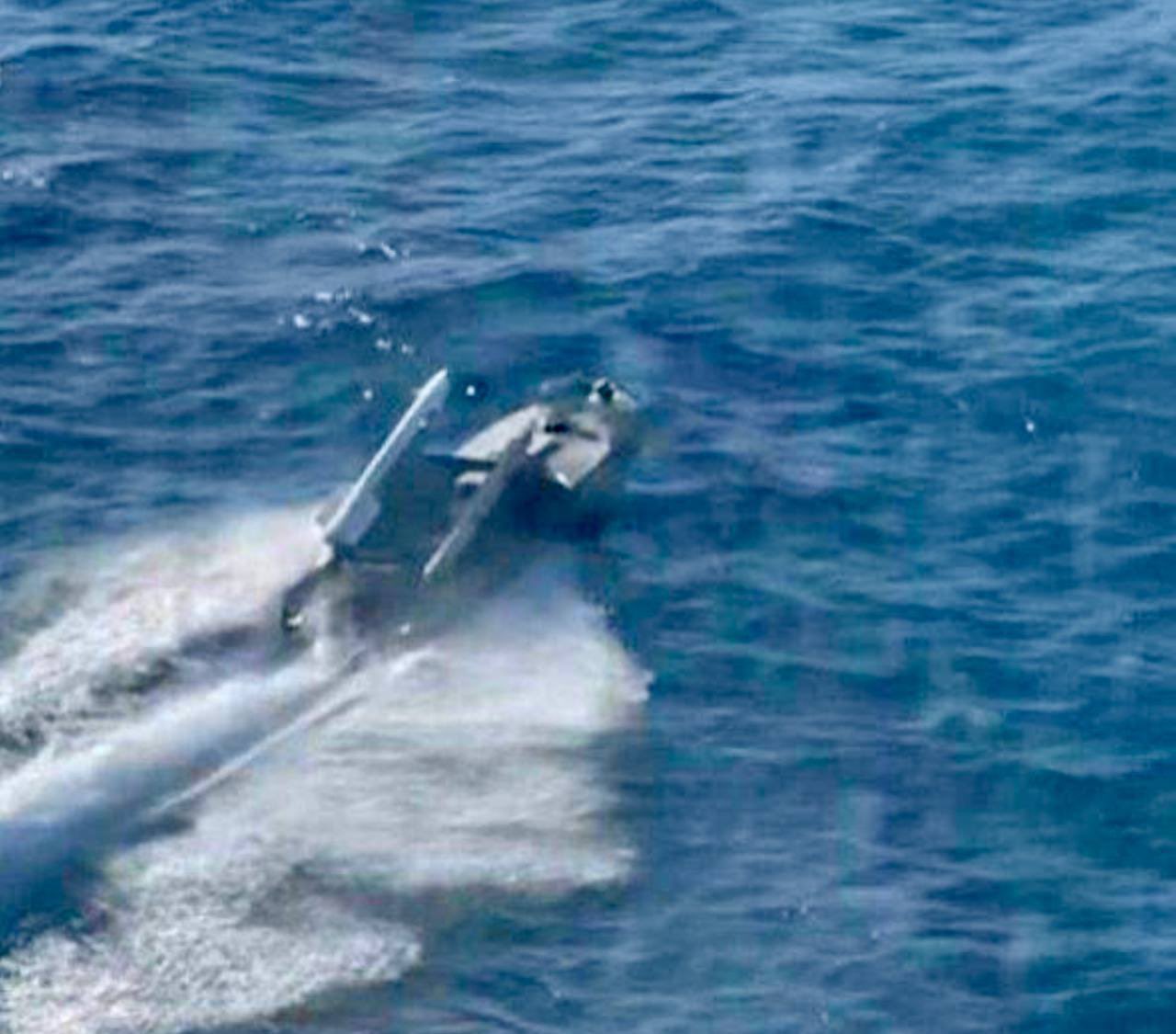
Thanks to Ukrainian drones, USVs, and UUVs, Russia has not only failed to exert dominance over the Black Sea but has also lost nearly one-third of its pre-war fleet, including the Moskva, corvettes like Ivanovets and Sergey Kotov, landing ships (such as Tsezar Kunikov), patrol boats, and, reportedly, even a Kilo-class submarine.
Despite lacking a conventional navy capable of direct ship-to-ship combat, Ukraine has achieved remarkable asymmetric success through innovation and unconventional tactics.
Ukrainian naval drones (USVs like MAGURA V5/V7 and the Sea Baby, as well as UUVs such as Sub Sea Baby) have set remarkable precedents:
- (a) In December 2024, the MAGURA V5 used modified R-73 air-to-air missiles (dubbed “Sea Dragon” surface-to-air missiles) to successfully engage and down two Russian Mi-8 helicopters during a battle near Crimea, marking the first time a naval drone destroyed aerial targets.
Today, Ukraine struck a Russian Mi-8 helicopter with a Magura V5 naval strike drone equipped with R-73 “SeaDragon” missiles off the coast of Cape Tarkhankut, Crimea.
Another helicopter was also hit by fire but was able to reach its base airfield. pic.twitter.com/mZ5hGsFyD0
— AMK Mapping
(@AMK_Mapping_) December 31, 2024
- (b) In May this year, the MAGURA V7 USV successfully deployed AIM-9 Sidewinder missiles to down a Russian Su-30SM fighter jet over the Black Sea. This was a historic first, demonstrating that a naval drone could destroy a manned combat aircraft.
On May 2, 2025, Ukraine’s Defence Intelligence (HUR MO) special unit Group 13, in coordination with the SBU and Defense Forces, destroyed a Russian Su-30 fighter jet using a Magura maritime drone. This marks the first time in history a combat aircraft has been taken down by… https://t.co/ipoPhMhOa8 pic.twitter.com/pYTEX48jNs
— Special Kherson Cat
(@bayraktar_1love) May 3, 2025


- (c) In December 2025, Ukraine made a groundbreaking claim that it used a Sub Sea drone (UUV) to strike and disable a Russian Kilo-class submarine docked at the Novorossiysk naval base. The Kilo-class submarines, armed with Kalibr cruise missiles, typically cost around USD 40 million each.
For the first time in history, Ukraine’s Security Service, together with the Ukrainian Navy, struck and disabled a russian Kilo-class (Project 636.3 “Varshavyanka”) submarine in Novorossiysk using underwater drones.
The cost of a Varshavyanka-class submarine is approximately $400… pic.twitter.com/QFkzGpT0nn— Defense of Ukraine (@DefenceU) December 16, 2025
Implications For The Future
The innovations in naval drones (USVs, UUVs, and high-altitude surveillance drones) will have profound implications for maritime warfare. It signifies that—
- (a) The traditional concept of naval power projection is nearly obsolete.
- (b) Sea control, a cornerstone of naval capabilities, will evolve due to UUVs, USVs, aerial drones, and high-altitude long-range surveillance technologies.
- (c) The role of large naval platforms, including aircraft carriers and submarines, will shift. Size may no longer be a strategic advantage but rather a potential vulnerability.
- (d) Aircraft carriers will likely remain in service, not for sea domination but as platforms for launching drones, aircraft, and missiles from a safer distance.
- (e) Smaller navies may focus on sea denial rather than direct domination. By leveraging naval drones, even less powerful navies can engage effectively in asymmetric warfare.
- (f) Enforcing port blockades no longer necessitates large fleets of destroyers or submarines; a coordinated use of UUVs and USVs, supported by high-altitude surveillance, could achieve the desired effects.
- (g) The relevance of long-range anti-ship hypersonic missiles will increase, potentially rendering aircraft carriers less effective in the coming decades.
As defense analyst Patricia Marins states, “The traditional concept of a navy capable of power projection is giving way to one of omnipresence: hundreds of UUVs, constant monitoring by high-altitude drones, and operations conducted within the envelope of long-range missiles.”
Is The US Seventh Fleet Vulnerable?
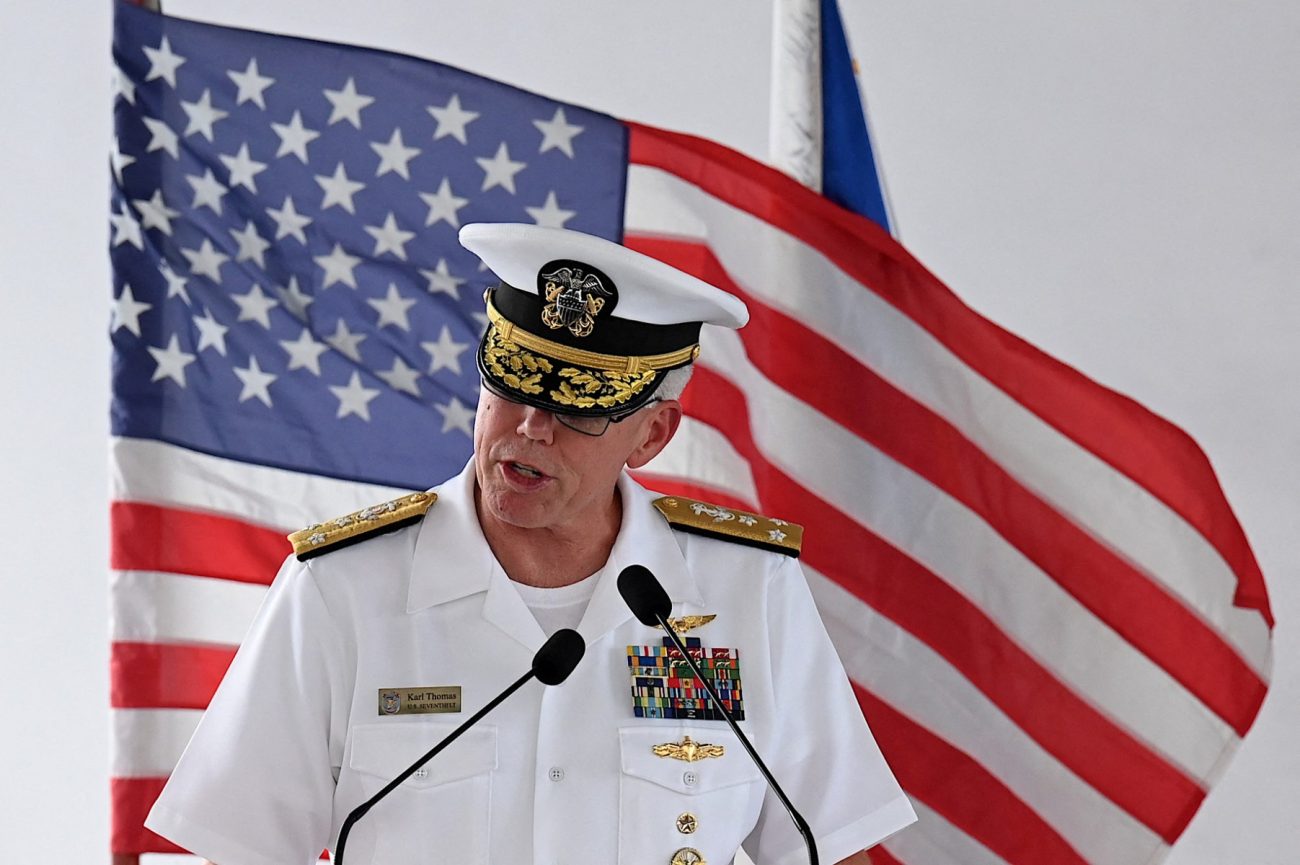
The Seventh Fleet is the largest of the U.S. Navy’s forward-deployed fleets. At any given time, it consists of 50-70 ships and submarines, 150 aircraft, and over 27,000 Sailors and Marines.
Seventh Fleet operates across more than 124 million square kilometers, spanning from the International Date Line to the India/Pakistan border and from the Kuril Islands in the North to Antarctica in the South.
This area includes some of the U.S.’s most significant adversaries—China, Russia, and North Korea—as well as five U.S. Mutual Defense Treaty Allies: the Philippines, Australia, South Korea, Japan, and Thailand.
USS George Washington (CVN 73) serves as the Navy’s forward-deployed aircraft carrier in the Seventh Fleet, spending about half of each year at sea.
This aircraft carrier, combined with guided-missile destroyers and cruisers, forms a carrier strike group comprising up to 12 ships and 75 aircraft.
In addition, the Seventh Fleet controls 10-14 destroyers and cruisers, which are equipped with Theater Ballistic Missile interceptors, long-range Tomahawk land-attack missiles, and anti-aircraft missiles.
The fleet also houses 8-12 nuclear-powered submarines, making it a formidable naval force. However, with advancements in USVs, UUVs, and hypersonic anti-ship missiles, the Seventh Fleet faces an increasing vulnerability.
In a potential conflict in the South China Sea, there are distinct advantages for Beijing:
- (a) China will be operating closer to home, allowing it to leverage its land bases for attacks, whereas the U.S. will be reliant on distant sea bases and allied locations.
- (b) China leads the U.S. in hypersonic anti-ship missile technology; missiles like the DF-26 have an operational range of 3000-5000 km compared to U.S. subsonic alternatives limited to 500-1500 km.
- (c) China possesses superior drone technology, with the capacity to quickly scale production due to its industrial capabilities.
Recently, China unveiled its new Wing Loong X drone, capable of autonomously detecting and attacking submarines, and is also testing extra-extra-large underwater drones (XXLUUVs) in the South China Sea, capable of reaching the U.S. West Coast.
“CHINA’S LATEST UNDERWATER DRONES MAY POSE A THREAT TO THE U.S. WEST COAST”
Recent reports from defense analysts highlight China’s development and testing of extra-extra-large uncrewed underwater vehicles (XXLUUVs), massive autonomous underwater drones comparable in size to… pic.twitter.com/Yjvmko5c6X
— WORLD AT WAR (@World_At_War_6) December 14, 2025
Earlier this year, China introduced “Feiyi,” the world’s first drone capable of transitioning between aerial flight and underwater navigation, launched from submarines.
With rapid advancements in USVs, UUVs, and hypersonic anti-ship missiles, China is poised to neutralize the Seventh Fleet’s advantages while undermining U.S. capabilities in nuclear-powered aircraft carriers and submarines.
As land and aerial warfare undergo hyper-accelerated changes, so too does naval warfare. A new paradigm, characterized by dispersed, nimble, and interconnected naval forces, could emerge to define future maritime conflicts.