


The U.S. Army’s 11th Airborne Division ran an extensive drone and counter-drone experimentation campaign in Alaska to study how unmanned systems and electronic warfare tools perform in extreme cold and a contested spectrum. The results aim to speed new tactics and technologies into the force as low-altitude airspace becomes more dangerous and more crowded.
On November 25, 2025, the U.S. Army disclosed that the 11th Airborne Division had conducted a large-scale unmanned aerial system (UAS) and counter-UAS experimentation campaign in Alaska’s Joint Pacific Alaskan Range Complex, using the Arctic as a live laboratory for electromagnetic warfare. In partnership with the Defense Innovation Unit and multiple industry vendors, the division combined electronic warfare (EW) teams, UAS operators, and counter-drone technologies to measure how these systems behave in extreme cold and a contested electromagnetic spectrum. The exercise reflects how lessons from Ukraine and other theaters are accelerating the integration of EW and counter-UAS at the tactical level, particularly in the airspace below 10,000 feet that is now crowded with small drones. This activity also supports the Army’s Arctic Strategy “Regaining Arctic Dominance,” which designates the 11th Airborne as the lead formation for cold-weather operations.
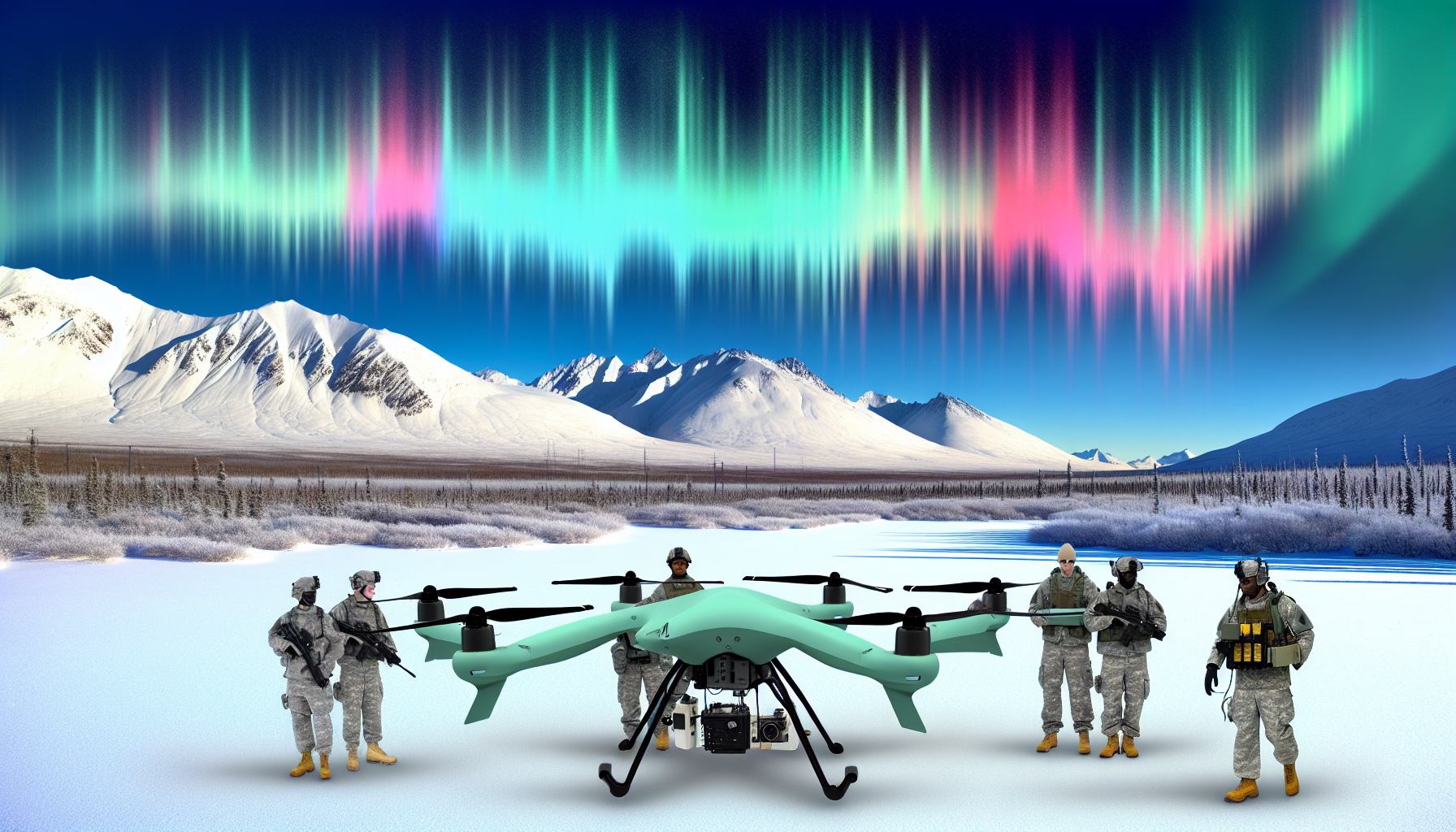
The U.S. Army’s 11th Airborne Division used Alaska’s Arctic ranges to blend drones, electronic warfare teams, and counter-drone tools in a large cold weather experiment that revealed how unmanned systems behave in extreme conditions and a congested electromagnetic spectrum (Picture Source: U.S. Army)
The heart of this experimentation lies in a suite of electronic warfare (EW) and counter-UAS tools rather than a single platform. The 11th Airborne Division brought together its organic EW platoons along with commercial UAS and counter-UAS systems to effectively detect, characterize, and defeat small drones across the icy expanses near Fort Greely and Fort Wainwright. Soldiers utilized their EW equipment to capture radio-frequency signatures, trace command-and-control links, and assess how jammers, sensors, and UAS payloads respond when temperatures plummet and snow obstructs mobility and line of sight.
Temperature impacts were significant, affecting battery performance and causing antenna icing that influenced data-link stability. These harsh conditions forced operators to adapt their power management and operational procedures. Concurrently, C-UAS vendors had the opportunity to analyze how their radars, passively cued RF detectors, and effectors functioned when atmospheric conditions distorted signals and when drones navigated low over rugged, snow-covered terrain.
This initiative is less about identifying a singular “winner” system and more focused on understanding which combinations of sensors, EW suites, and UAS platforms yield a reliable picture of the “invisible battlefield” prevalent in the Arctic airspace.
This experimentation partakes in a broader trajectory in operational and capability development for the newly reactivated 11th Airborne Division. Reactivated in 2022, this division serves as the Army’s dedicated Arctic formation under the “Regaining Arctic Dominance” strategy. The Joint Pacific Alaskan Range Complex is one of the Department of Defense’s premier multi-domain training environments, offering expansive instrumented air and land space for the integration of live, virtual, and constructive assets. In recent years, the division leveraged this range and the Joint Pacific Multinational Readiness Center–Alaska to validate Arctic mobility, air-assault tactics, and cold-weather sustainment.
The incorporation of dedicated electronic warfare and counter-UAS trials into this rich landscape of military exercises extends the division’s capability development from mere maneuver sequences into the electromagnetic domain. This transformation signals a commitment to evolving from classroom concepts to data-driven evaluations, ensuring that skills previously learned through live combat conditions can now be institutionalized as formal tactics, techniques, and procedures for scaled operations.
When compared to counter-UAS events in milder climates, the Alaskan campaign offers distinct advantages. For instance, events like Project FlyTrap 4.5 in Germany tend to focus on evaluating lower-cost sensors and munitions for NATO’s Eastern Flank, connecting them to established command-and-control networks to monitor and neutralize small drones. In contrast, the challenges facing the 11th Airborne involve assessing how existing families of sensors, EW tools, and UAS platforms perform under extreme cold, which can compromise battery life, reduce radar effectiveness at low elevation angles, and complicate overall maintenance and logistics.
These trials complement European efforts by rigorously testing contrasting systems under the harshest environments expected by the Army. The data collected here will sharpen not just technical requirements—such as power management protocols and environmental hardening—but also strategic doctrine on how to synchronize EW and kinetic tools, ensuring that friendly drones remain unharmed in cluttered electromagnetic environments. Such synchronization has been a pressing concern highlighted by combat operators engaged in the ongoing conflict in Ukraine.
Strategically, these trials transcend a single divisional exercise’s implications. The Arctic has increasingly come into focus within defense strategies of the U.S., Russia, and China due to the emergence of new maritime routes, undersea communication networks, and long-range missile pathways converging in this region. By honing systems that can detect and counter small drones operating amidst these challenges, the 11th Airborne Division boosts the security of vital U.S. and allied infrastructure while reinforcing deterrence within the High North.
Moreover, the ability to control airspace up to 10,000 feet through an integrated use of unmanned aerial systems (UAS), electronic warfare (EW), and counter-UAS (C-UAS) technologies plays a key role in supporting homeland defense operations under NORAD and U.S. Northern Command. The insights gained here also offer tactical advantages and lessons beneficial to allies facing similar drone proliferation challenges across Europe and the Indo-Pacific regions.
By embedding EW and counter-UAS training into Arctic exercises, the 11th Airborne Division ensures that any future deployments—whether for crisis response within Alaska, bolstering NATO’s northern defenses, or undertaking operations in other challenging cold-weather environments—will rely on refined, effective procedures rather than haphazard improvisation against aerial and electronic threats.
The UAS experimentation spearheaded by the 11th Airborne Division in Alaska marks a pivotal shift from merely observing global drone warfare to actively crafting solutions for forthcoming conflicts in one of the world’s most daunting theaters. Through the convergence of electronic warfare expertise, pioneering industry innovations, and the unique settings of the Joint Pacific Alaskan Range Complex, the Army effectively turns the Arctic into a testing ground for counter-UAS strategies, enhancing relevance from the High North all the way to Eastern Europe.
As the Army assimilates lessons related to RF signatures, battery performance in severe cold, and spectrum congestion, these findings will inform future acquisitions, training, and operational tactics. The clear message to both allies and adversaries is that the United States is evolving to meet the demands of the drone and EW era, especially in conditions where even the smallest technological advantages can dictate air dominance.
Written by Teoman S. Nicanci – Defense Analyst, Army Recognition Group
Teoman S. Nicanci holds degrees in Political Science, Comparative and International Politics, and International Relations and Diplomacy from leading Belgian universities, with research focused on Russian strategic behavior, defense technology, and modern warfare. He is a defense analyst at Army Recognition, specializing in the global defense industry, military armament, and emerging defense technologies.