



The US often accuses China of copying its weapons platforms. However, in a reversal of sorts, the US has not only copied the Iranian-designed Shahed-136 drones but also deployed them in the Middle East as a not-so-subtle message to Tehran.
The US Central Command (CENTCOM) officially announced the formation of a new task force, Task Force Scorpion Strike (TFSS), which marks the US military’s first one-way attack drone squadron based in the Middle East. This move highlights the growing reliance on drone technology in modern warfare.
Task Force Scorpion Strike was established just four months after Secretary of War Pete Hegseth pushed for an accelerated acquisition and deployment of cost-effective drone technologies. The TFSS aims to provide the US military with low-cost, effective drone capabilities rapidly.
LUCAS – A Shahed-136 Replica
The LUCAS drones being utilized by the TFSS are remarkably similar to the Iranian-designed Shahed-136 drones. Reports indicate that LUCAS was developed after US developers reverse-engineered a captured Shahed drone, showcasing an innovative approach to military technology. This development underscores the ingenuity within US defense circles, even in the face of allegations of copying.
According to CENTCOM, LUCAS drones are engineered for extensive range and autonomy. They can be launched using various methods, including catapults, rocket-assisted takeoff systems, and mobile ground/environmental launch systems, enhancing their operational flexibility.
Unveiled in July this year at the Pentagon, LUCAS has been developed by Arizona-based defense contractor SpektreWorks. It promises a scalable and affordable answer to the challenges of tactical drone warfare, similar to the capabilities offered by Iran’s Shahed series.
The triangular delta-wing design of the LUCAS drone measures about 10 feet in length with an 8-foot wingspan, optimized for long-range loitering missions, adding a tactical edge over traditional UAVs.
However, LUCAS stands out in its engineering. Powered by a two-cylinder DA-215 engine, this model offers enhanced fuel efficiency compared to the Shahed’s four-cylinder counterpart, all while maintaining a lower acoustic signature.
Its modular open architecture enables the integration of various payloads, ranging from reconnaissance equipment to electronic warfare devices, allowing it to adapt to various mission profiles effectively.
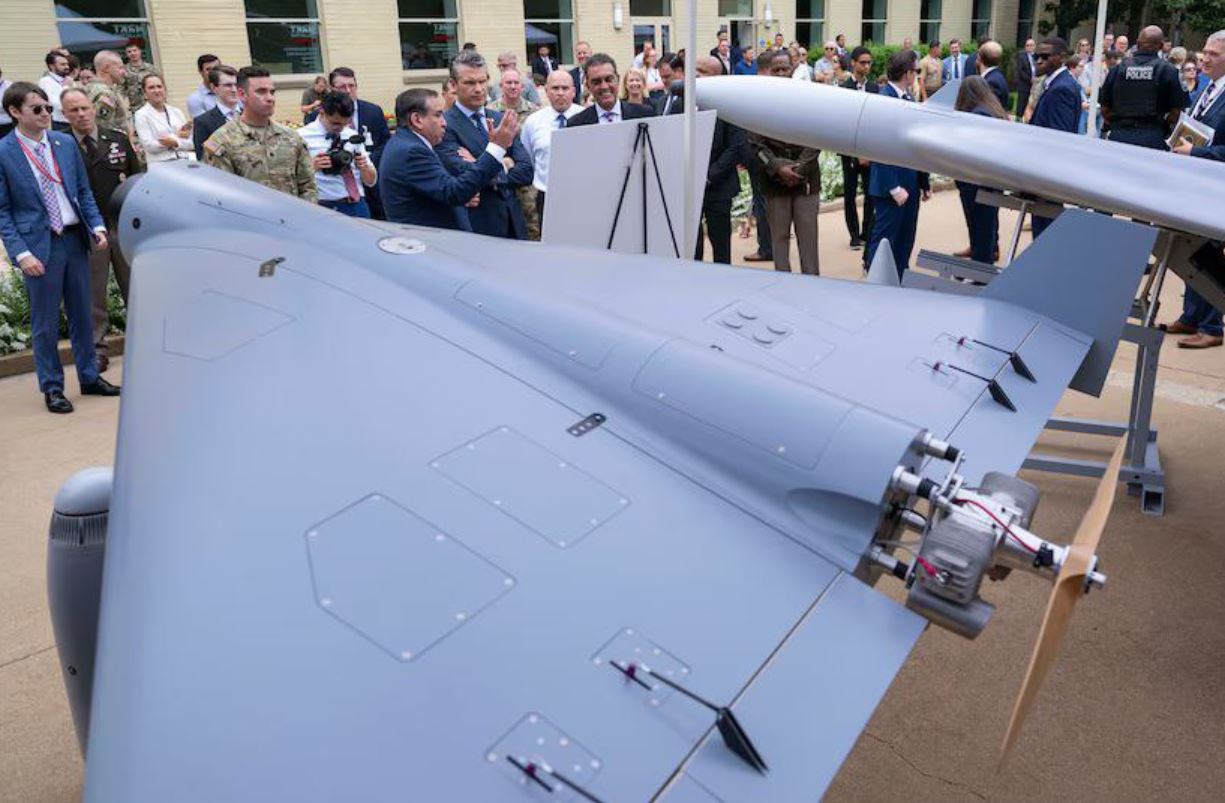
LUCAS supports multiple launch methods, including Rocket-Assisted Take-Off, and can be deployed from trucks, making it accessible for personnel with limited training. It is also adaptable for maritime deployment.
In terms of utility, LUCAS differs from the single-use Shahed-136 by being reusable in specific roles such as reconnaissance, improving its overall cost-effectiveness. Operating on flexible power supplies, it supports diverse payloads, further reinforcing its mission adaptability.
Additionally, LUCAS is equipped with a Multi-domain Unmanned Systems Communications mesh network, enabling autonomous swarm operations and network-centric strikes. This capability allows the drone to function as a communication relay in contested environments, where standard communication lines may be compromised.
With an estimated cost of around USD 35,000, LUCAS is a low-cost, scalable system that presents advanced capabilities compared to traditional long-range US military systems.
The resemblance between LUCAS and the Iranian Shahed-136 hasn’t gone unnoticed. Observers have pointed out that LUCAS closely resembles the Shahed-136 and even the Russian Geran-2 drones, which have been used extensively in the conflict in Ukraine.
“Designed by a US defense startup, it’s virtually identical to Iran’s ‘Shahed-136’ and Russia’s ‘Geran-2’ UAVs,” noted a report by RT.com.
In August, the Eurasian Times reported that the US Air Force indicated interest in producing replicas of the Shahed-136 to develop and test defenses against this Iranian-designed system.
The Request for Information (RFI) revealed the USAF aims to procure copies of the Shahed-136, intending to purchase 16 of these drones initially, with options for additional acquisitions later. This procurement signals a strategic evaluation of the Shahed’s threat level and an effort to enhance defensive measures against similar capabilities.
The RFI underscored the significance of the Shahed-136 drones as a drone threat, especially given their use in conflicts and the difficulties they pose in detection and interception.
The Shahed Drones in the Ukraine War
The Shahed-136 drones have gained notoriety for their terrain-hugging flight paths and carbon-fiber bodies, making them exceptionally challenging to detect. These drones have presented a significant challenge for defense systems, particularly as they approach targets low and fast.
Ukraine has been grappling with countermeasures against the Russian Geran-2 drones, as they increasingly form the backbone of Russian aerial assaults during the ongoing conflict.
Moreover, these Iranian drones have been operationally employed against US forces, particularly in the Middle East, demonstrating their versatility and effectiveness in various combat scenarios.
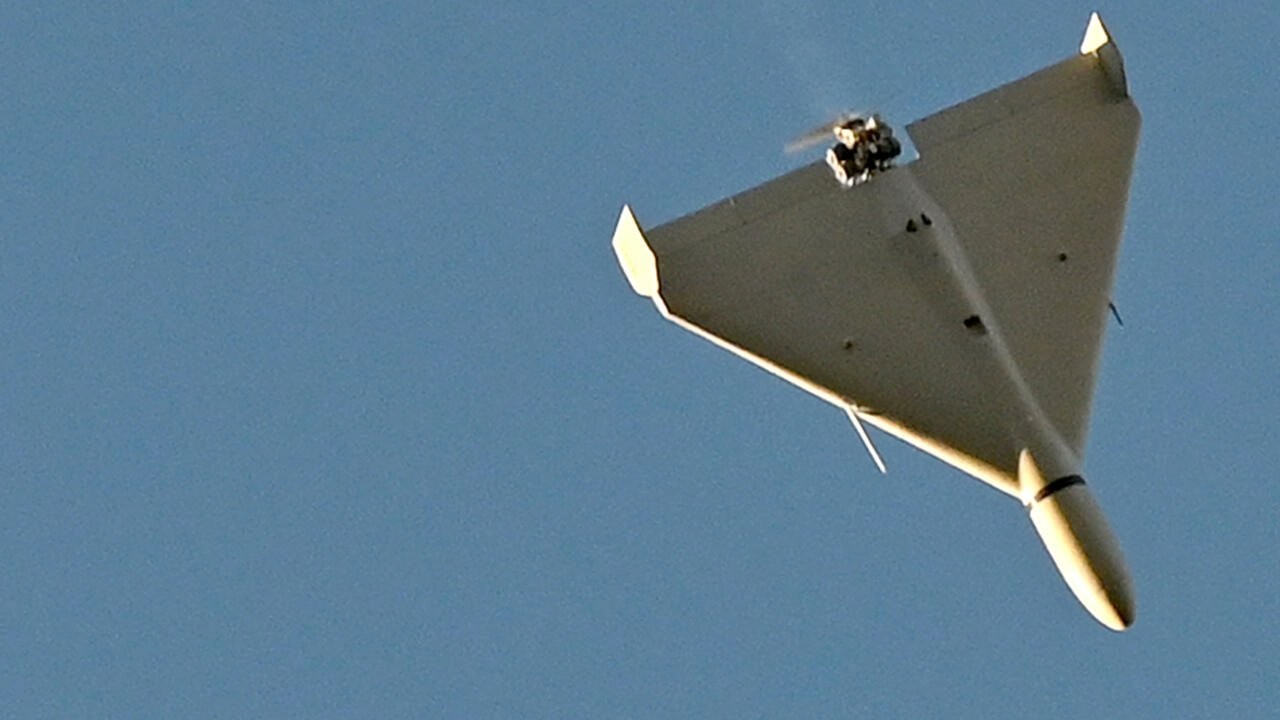
For instance, in January last year, a Shahed-136 drone managed to strike a US military position in Jordan, resulting in casualties. Such incidents underline the operational risks posed by these drones not only to US forces but also to allies in the region.
As a direct consequence, nations across the globe, including China and North Korea, are now developing their versions of one-way attack drones, often drawing inspiration from the capabilities exhibited by the Iranian Shahed-136.
This is
China’s version of the Geran-2 Drone, The Feilong-300D Suicide Drone, a low cost-High performance drone, and the future of combat.
It carries a High-explosive warhead, and has a range of over 1000km in just a cost of $10,000 USD. pic.twitter.com/XZBEGW1AoK
— PLA Military Updates (@PLA_MilitaryUpd) November 2, 2025
China’s LOONG M9 and the Feilong-300D both illustrate this trend, as they bear significant resemblances to the Iranian Shahed-136. Additionally, US companies, including Griffon Aerospace, are developing drones like the MQM-172 Arrowhead, which is reportedly based on the same principles as the Shahed-136.
A new U.S.-made version of Shahed kamikaze drone — MQM-172 Arrowhead. pic.twitter.com/dSOr7VoHF9
— MAKS 25
(@Maks_NAFO_FELLA) August 8, 2025


The advancement and deployment of LUCAS in the Middle East serve as a powerful signal to Iran. The US has successfully developed comparable low-cost, scalable, hard-to-detect, long-range drones, and they have reached operational readiness, asserting the US military’s confidence in leveraging advanced drone technology right in Iran’s vicinity.
- Sumit Ahlawat has over a decade of experience in news media. He has worked with Press Trust of India, Times Now, Zee News, Economic Times, and Microsoft News. He holds a Master’s Degree in International Media and Modern History from the University of Sheffield, UK.
- VIEWS ARE PERSONAL OF THE AUTHOR.
- He can be reached at ahlawat.sumit85 (at) gmail.com