


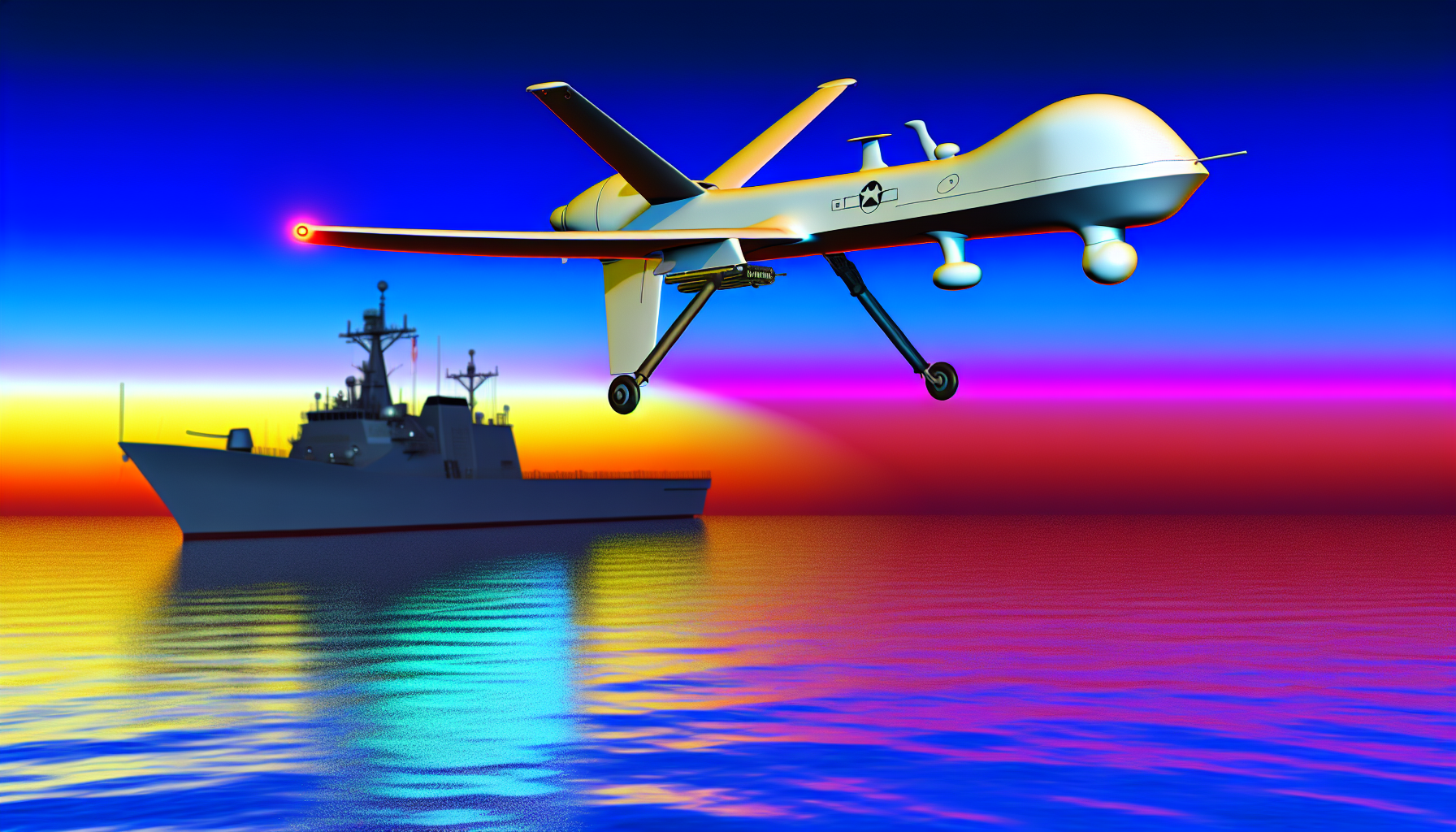
This week marked a pivotal moment in military technology as the USS Santa Barbara, a US Navy Independence-class littoral combat ship, successfully launched a Low-cost Unmanned Combat Attack System (LUCAS) drone in the Arabian Gulf. This event represents the first deployment of a one-way attack drone from a naval vessel by the American military, pointing to an evolving landscape of military strategy that emphasizes innovation and efficiency.
Vice Adm. Curt Renshaw, who leads US Naval Forces Central Command, termed the launch a “significant milestone.” He emphasized that the integration of cost-effective drones significantly enhances operational capabilities for US forces stationed in crucial geographic areas. The LUCAS drone, designed as a one-way attack system, showcases advanced unmanned aerial technology. It is engineered to loiter in a designated target area before descending to strike, thus maximizing its effectiveness while minimizing operational costs.
The establishment of a squadron specifically tasked with operating LUCAS in the Middle East underscores the US military’s pivot towards lower-cost, high-impact technological solutions. These drones are characterized by an extensive range, enabling them to perform catapult launches and utilize rocket-assisted takeoffs, thereby adapting seamlessly to a variety of deployment conditions. This adaptability is particularly crucial in regions marked by diverse operational challenges.
Adm. Brad Cooper, commander of CENTCOM, praised the incorporation of LUCAS as a significant enhancement to the US Navy’s warfighting capabilities. He noted that these drones enhance deterrence and striking power from maritime settings, freeing up traditional assets for other critical missions. This deployment also highlights the evolutionary role of littoral combat ships like the Santa Barbara, which are increasingly integrating drone technology into their armaments, potentially amplifying their effectiveness in complex maritime operations.

The launch occurred near Iranian waters, coinciding with a period when the US is actively seeking innovative strategies to maintain competitiveness among global military powers. This includes keeping pace with emerging threats from nations like Russia and China. Secretary of Defense Pete Hegseth recently announced a forthcoming $1 billion investment to speed up the production and deployment of inexpensive drones over the next two years. This investment underscores the military’s commitment to adapting to the growing prevalence of robotic and autonomous systems in modern warfare.
The concept behind LUCAS drones aligns with historical observations regarding the effectiveness of similar unmanned systems in past conflicts. Designed with features reminiscent of the Iranian Shahed-136, the LUCAS drone is part of a broader trend toward low-cost, high-utility combat solutions. Such designs have demonstrated their operational success in various engagements, including the ongoing Ukraine conflict where both sides have leveraged drone technology extensively.
While the LUCAS system is aimed at enhancing regional maritime security, its deployment in active combat scenarios remains uncertain. Nonetheless, these recent developments signal the US Navy’s proactive stance in adapting to contemporary warfare challenges, prioritizing innovation, affordability, and improved effectiveness in both force projection and deterrent capabilities.