


Analyzing China’s Potential Strategy to Block Starlink Access in Taiwan
A new study by military researchers in China has offered a compelling insight into how the Chinese government might attempt to disrupt Starlink internet access across Taiwan. The report, highlighted by the South China Morning Post (SCMP), outlines a scenario in which a large-scale deployment of electronic warfare drones could be employed to jam Starlink signals throughout the island. This research comes at a critical juncture, as concerns about China’s electronic warfare capabilities grow amidst rising geopolitical tensions and the increasing reliance on satellite communications globally.
Understanding the Context of the Study
Conducted by teams from Zhejiang University and the Beijing Institute of Technology—both institutions with strong ties to China’s defense sector—the study specifically examined how the People’s Liberation Army (PLA) could hinder Taiwan’s access to Starlink, operated by SpaceX. With over 10,000 satellites currently orbiting Earth, Starlink has become integral to the global communications landscape. Its resilience was notably demonstrated in Ukraine, where it provided crucial connectivity amidst severe cyberattacks and missile strikes. This success has caught Beijing’s attention, particularly as Taiwan is perceived as a potential battleground where dominance in communication could be pivotal.
The Simulated Warfare Strategies
To assess the viability of disrupting Starlink coverage, the researchers created simulations mirroring the satellite positions, signal behavior, and link variability over an area equivalent to Taiwan. The simulations examined a 12-hour period, reflecting the dynamic nature of Starlink’s mesh network, designed to mitigate service interruptions by routing data through multiple satellites rather than through a select few.
Rethinking Electronic Warfare Tactics
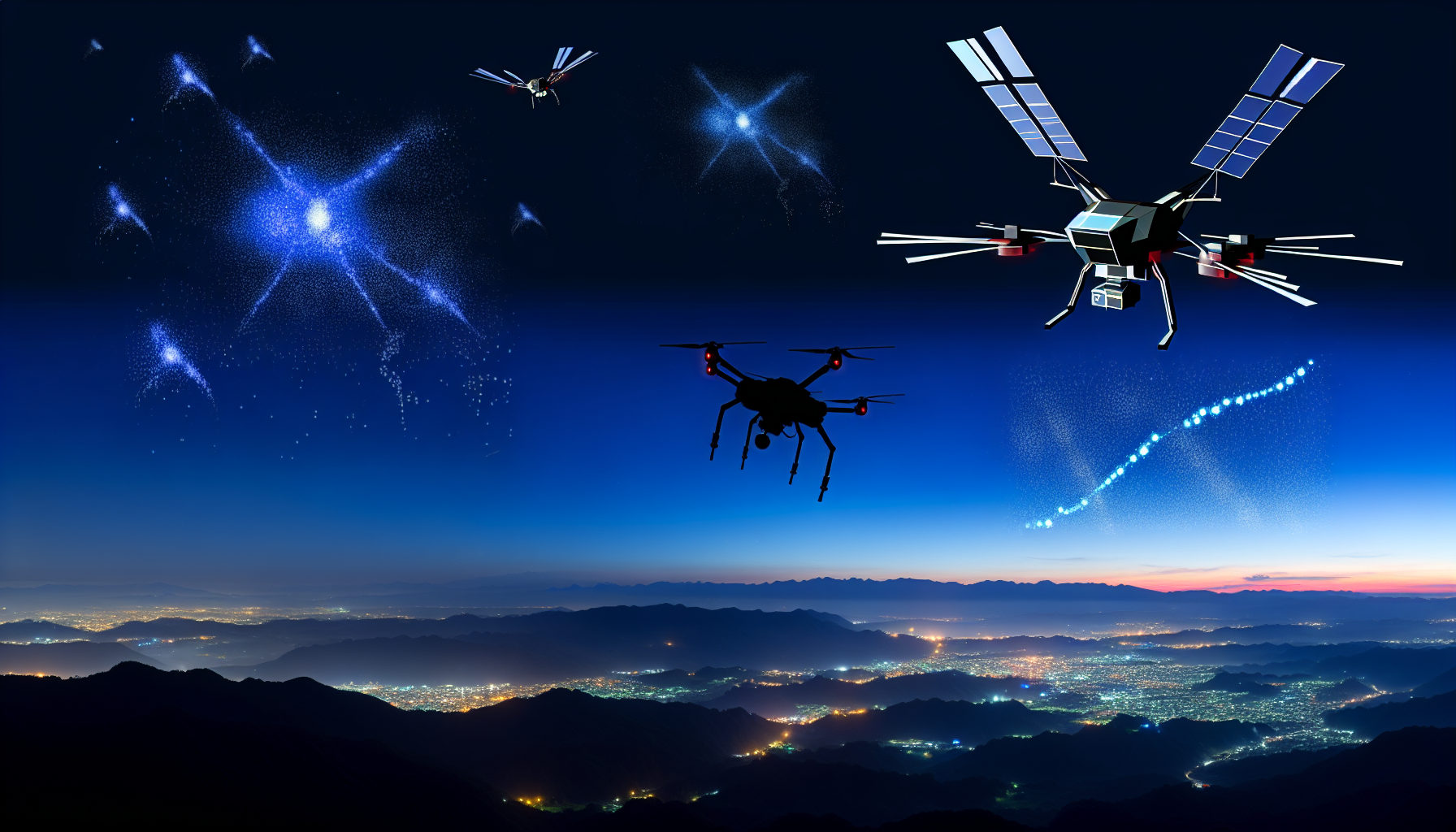
A notable conclusion from the study is that Starlink’s decentralized architecture makes it highly resistant to typical jamming methods. A singular jammer or even multiple high-powered jammers would be ineffective, as Starlink terminals can switch between satellites seamlessly. Consequently, the study advocates for a large-scale, distributed jamming operation—essentially creating an airborne grid of electronic interference devices. These jammers would need to be deployed via drones, balloons, or aircraft, operating in concert to establish an “electronic fog” over significant areas of Taiwan’s airspace.
The jammers would be strategically spaced between 3 to 6 miles apart and would extend approximately 12 miles upward into the atmosphere. The objective of this deployment would be to overwhelm communication links between Taiwan-based Starlink terminals and overhead satellites, ultimately disrupting the network’s capacity to maintain stable connections.
The Logistical Challenges of Jamming
Under ideal conditions, the study suggests that around 935 jamming nodes would suffice to impede Starlink signals across Taiwan. However, acknowledging the challenges of practical operations, researchers estimated that the PLA would likely require approximately 2,000 drones equipped with jamming technology to achieve effective disruption in real-world settings. Coordinating such a vast fleet presents a significant logistical challenge involving launching, controlling, and maintaining drones, navigating contested airspaces, and countering Taiwan’s defensive measures. Continuous operation would also impose considerable strain on drone batteries and onboard systems.
It’s worth noting that the study did not delve into how such a large drone fleet could be defended against anti-drone systems or missile interceptors, nor did it consider how long the jamming network would need to remain functional. However, the scale indicated reflects China’s perception of Starlink as a formidable strategic hurdle.
Taiwan’s Countermeasures: Strengthening Drone Defense
Recognizing the potential for a saturated drone offensive from China, Taiwan is proactively ramping up its drone defense capabilities. Concerns about Chinese use of unmanned aircraft for surveillance and offensive operations have spurred the island to make significant investments in indigenous research and foreign partnerships aimed at developing sophisticated anti-drone technologies. This includes radar-guided air defense systems, electronic countermeasures, and kinetic interceptors designed to neutralize drone swarms.
Given Taiwan’s status as a leading global semiconductor hub, with key players such as TSMC, MediaTek, and Asus forming the backbone of global tech supply chains, safeguarding communication infrastructure is of utmost importance. Some analysts propose that Taiwan might explore a multi-layered air defense system, akin to Israel’s Iron Dome but tailored for drones and electronic threats rather than traditional rockets. Such a strategy could integrate radar, jamming tools, and aerial interceptors, effectively countering large-scale drone offensives envisioned in the Chinese study.
This structured examination of the recent research sheds light on a complex web of military strategy, technological advancement, and international relations, highlighting the intricate balance between defense and disruption in modern warfare.