


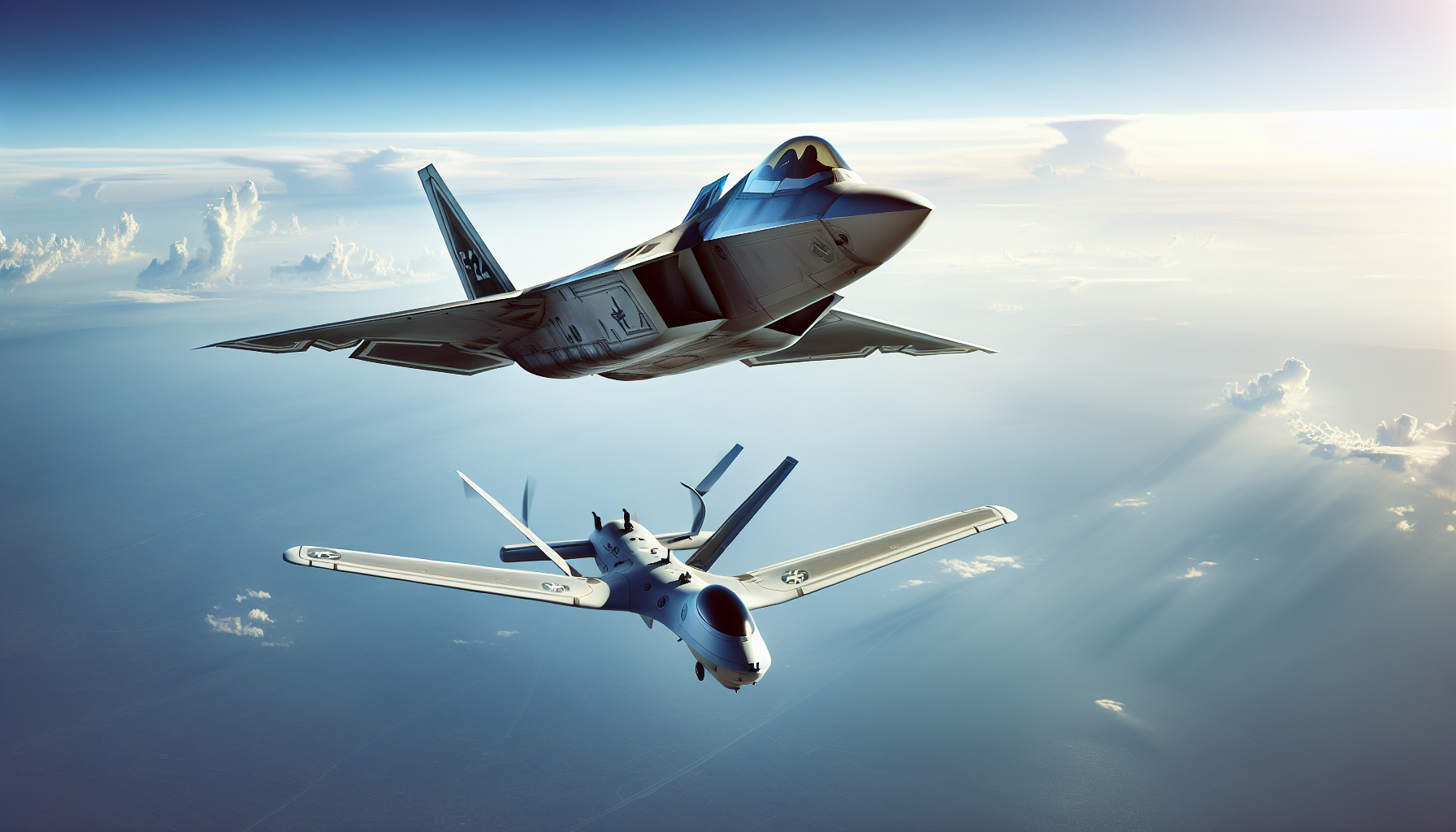
The Future of Air Combat: Human Pilots and Autonomous Drones
In a pioneering step toward the future of aerial warfare, a crewed US Air Force fighter jet recently flew alongside an uncrewed jet-powered aircraft, demonstrating how autonomous drones may operate in conjunction with human pilots. This test was part of the efforts by US defense firm General Atomics, which is actively involved in the Air Force’s Collaborative Combat Program (CCP). The aim? To develop a new generation of loyal wingman-type drones that can enhance the capabilities of human pilots in combat scenarios.
The Collaborative Combat Program
General Atomics has been at the forefront of this initiative, pushing the boundaries of what is possible with unmanned aerial vehicles (UAVs). The recent flight test featured the MQ-20 Avenger drone cooperating with an F-22 Raptor, a move that signifies the trajectory of future air operations. During the test, the F-22’s pilot was not merely controlling the aircraft but also directing the drone to perform intricate tactical maneuvers, conduct combat air patrols, and engage in airborne threat engagements.
Advancing Through Technology
This demonstration builds on previous efforts, particularly a test from November 2025, where an F-22 pilot utilized a tablet to issue commands to the MQ-20 during flight. Such technological advancements are pivotal in enhancing in-flight communication and command execution. In the most recent test, the pilot used government-provided autonomy software paired with a tactical data link to relay commands to the drone in real-time.
David Alexander, president of General Atomics Aeronautical Systems, pointed out that this demo effectively integrated mission elements, harnessing the drone’s onboard sensors for independent decision-making while still executing commands from the F-22. This synergy between manned and unmanned aircraft could redefine strategies in modern air combat.
The Role of Autonomous Drones
General Atomics’ demonstration underscores the potential impact of CCA-type platforms in bolstering the combat power available to pilots. The Air Force views these drones not as disposable assets but as valuable, cost-effective components designed to augment human capabilities. Built to be attritable—meaning they can be engaged in combat without the same level of risk as human-piloted aircraft—they represent a strategic shift in resource management during conflicts.
The vision for these Collaborative Combat Aircraft encompasses a future where several drone platforms, including General Atomics’ YFQ-42, Anduril’s YFQ-44, and Northrop Grumman’s YFQ-48A, can operate seamlessly with advanced crewed fighter jets. These systems are being developed to be easily upgradable, ensuring compatibility with evolving technologies and mission requirements.
Adding Firepower and Intelligence
The operational capabilities of CCA-type drones extend across various mission objectives, including air-to-air combat, strike missions, and intelligence gathering. In addition to performing roles autonomously, these drones can amplify the effectiveness of a formation by introducing additional sensors and weaponry, all without the need for another pilot.
The phrase “attritable force multiplier” aptly describes their intended function. By working alongside crewed fighter jets, these drones aim to transform how pilots engage with artificial intelligence and extend U.S. airpower in confrontations, particularly against near-peer adversaries.
A Partnership in the Sky
Despite the advanced capabilities of these drones, the Air Force emphasizes that they are not envisioned as replacements for existing crewed aircraft. Instead, the future of air combat relies on an integrated approach where pilots and drones work collaboratively. This strategic partnership is set to reshape the dynamics of warfare, enabling human operators to leverage AI more effectively while maintaining oversight.
Conclusion
The recent collaboration between the F-22 Raptor and the MQ-20 Avenger is just a glimpse of a future where human and autonomous pilots operate in tandem, revolutionizing how missions are conducted. As technology progresses, these advancements promise not only to enhance operational efficiency but also to redefine the very fabric of aerial warfare.