


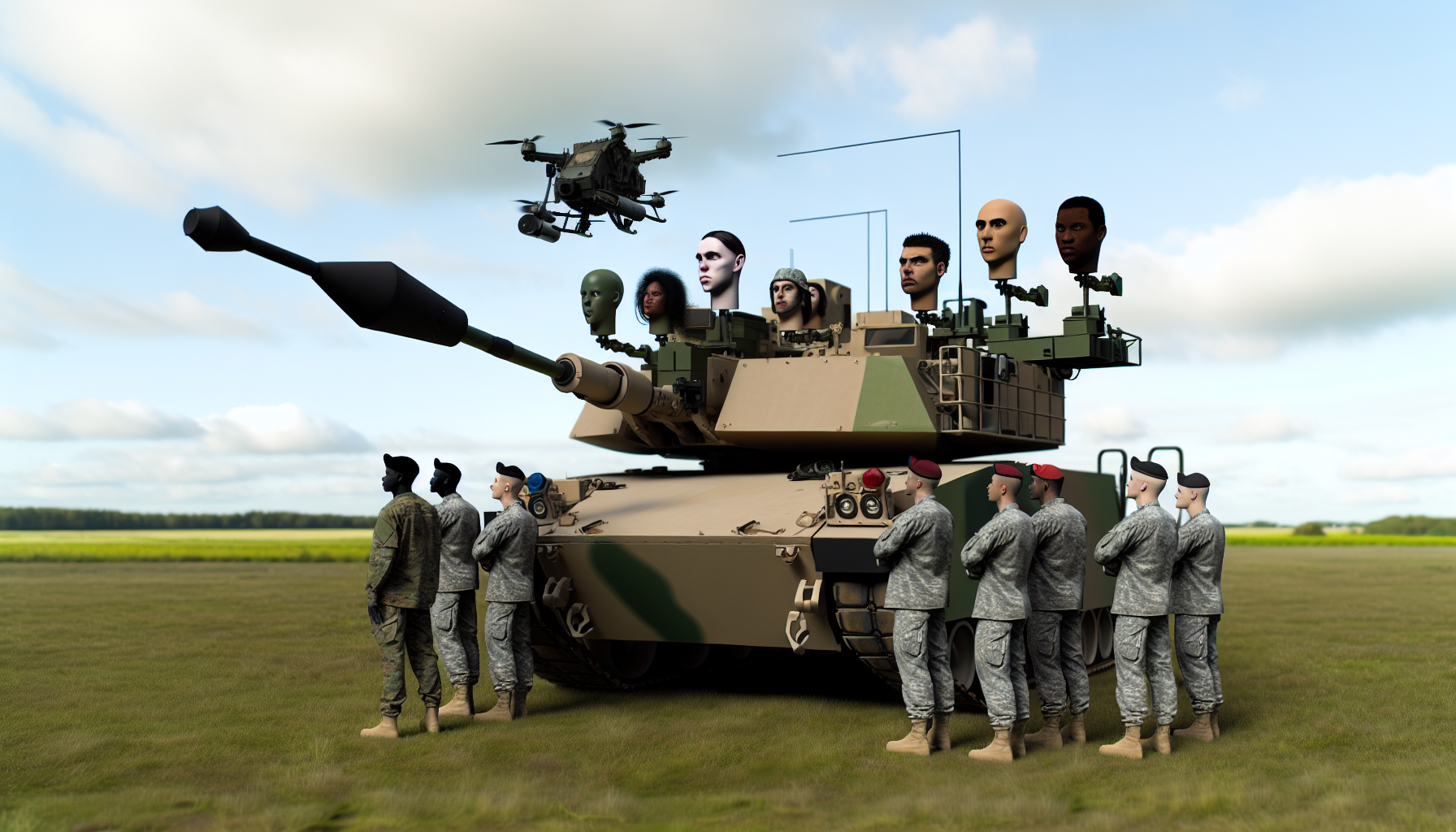
The US Army is testing Allen Control Systems’ Bullfrog counter-drone weapon station on Abrams tanks and Bradley IFVs, a crucial response to the urgent need for frontline armor defenses against the evolving drone threat seen in Ukraine and the Middle East.
On 30 October 2025, Allen Control Systems announced on X that the US Army had commenced evaluating the integration of its Bullfrog autonomous counter-drone weapon station specifically on Abrams main battle tanks and Bradley infantry fighting vehicles. This initiative marks a significant step towards equipping frontline armored units with effective defenses against the escalating threat posed by small, fast, and low-cost unmanned aerial vehicles (UAVs). The Army’s move is particularly relevant in light of its observations from recent conflicts, especially in Ukraine and the Middle East, where drones have been employed like airborne improvised explosive devices (IEDs) against armored vehicles. Rather than exploring a distant concept, the Army is currently assessing an actual system that has been mock-mounted on operational platforms, clearly indicating a desire for a vehicle-level response to these emerging threats.
The US Army is testing Allen Control Systems’ Bullfrog counter-drone turret on Abrams and Bradleys (Picture Source: Allen Control Systems)
The testing phase primarily focuses on the integration of the Bullfrog system onto existing U.S. ground vehicles. Photographs released by Allen Control Systems illustrate Bullfrog modules mounted on the rear roofline of a Bradley and on the upper surface of an Abrams turret, with optronics placed to the side and the weapon cradle elevated. Even in their mock-up forms, these installations suggest the turret can be fitted without extensive redesigns. This configuration allows for unobstructed views from current sights and hatches while providing the crew with a comprehensive field of coverage, including high-angle shooting capabilities. This elevation is particularly significant since traditional remote weapon stations on U.S. vehicles were designed to combat dismounted troops and light vehicles, not the quadcopters that can descend vertically onto vulnerable surfaces like an engine deck. The Army is evaluating whether Bullfrog could be deployed as an add-on kit that line units could quickly install and maintain with minimal disruption.
Beyond assessing simple fit, the trials aim to quantify the performance benefits that Bullfrog brings compared to standard machine-gun stations. This system focuses on a 12.7 mm (.50 cal) weapon operating at a cyclic rate of approximately 600 rounds per minute, combined with advanced sensors and software designed to identify, categorize, and engage Group 1 to Group 3 UAVs up to around 1,500 meters away. This capability would equip both Abrams and Bradley vehicles with a localized hard-kill anti-drone defense that operates in autonomous or semi-autonomous modes, thus reducing the crew’s exposure when operating in the hatch. Given that drones are increasingly used as loitering munitions, having a swift reaction time is critical. An automated, stabilized turret already tracking targets will likely respond more rapidly than a manual CROWS system, optimizing the defensive response. This strategy aligns with the U.S. Army’s approach to distributing small, mobile defensive capabilities across platforms rather than consolidating protective assets solely within a few M-SHORAD vehicles.
The report also raises questions about how Bullfrog would integrate with existing defensive systems and the overall costs associated with its deployment. Abrams tanks equipped with Trophy and Bradleys outfitted with Iron Fist already feature robust defenses against anti-tank guided missiles (ATGMs) and rocket-propelled grenades (RPGs), though these systems were not specifically designed to pursue slow-moving, erratic, low-profile quadcopters. Conventional CROWS mounts or fixed M2/M240 weapon systems could address such threats; however, they rely heavily on the gunner’s situational awareness. Bullfrog aims to bridge this capability gap by offering superior elevation, automated detection features, and a relatively lightweight architecture of 165 pounds, potentially adaptable to allied platforms. Notably, Allen Control Systems did not announce any production contracts with the U.S. Army in its 30 October 2025 communication, implying that the project is still in the evaluation or rapid prototyping stages rather than entering a formalized production phase.
This announcement signals the U.S. Army’s acknowledgment of small drones as a persistent threat to armored units, leading to efforts in collaboration with agile suppliers to regain tactical control. Should Bullfrog, or a modified version, succeed through live-fire trials, Abrams and Bradleys could benefit from an organic, readily available anti-drone layer. This would complement existing active protection systems and higher-echelon air defense mechanisms, enhancing the operational survivability and mobility of U.S. and allied mechanized forces in drone-saturated environments without relying solely on external protective cover.
Written by Teoman S. Nicanci – Defense Analyst, Army Recognition Group
Teoman S. Nicanci holds degrees in Political Science, Comparative and International Politics, and International Relations and Diplomacy from leading Belgian universities, with research focused on Russian strategic behavior, defense technology, and modern warfare. He is a defense analyst at Army Recognition, specializing in the global defense industry, military armament, and emerging defense technologies.