


Understanding NATO’s Covert Operations: The Royal British Marines and U-35 in Cold Response 26
In a remarkable demonstration of allied collaboration, the Royal British Marines, in coordination with the German Navy, executed a covert operation during Exercise Cold Response 26 in Norway. This exercise took place from March 9 to March 19, involving around 25,000 troops from 14 allied nations, showcasing NATO’s commitment to enhancing its defensive strategy along its northern flank.
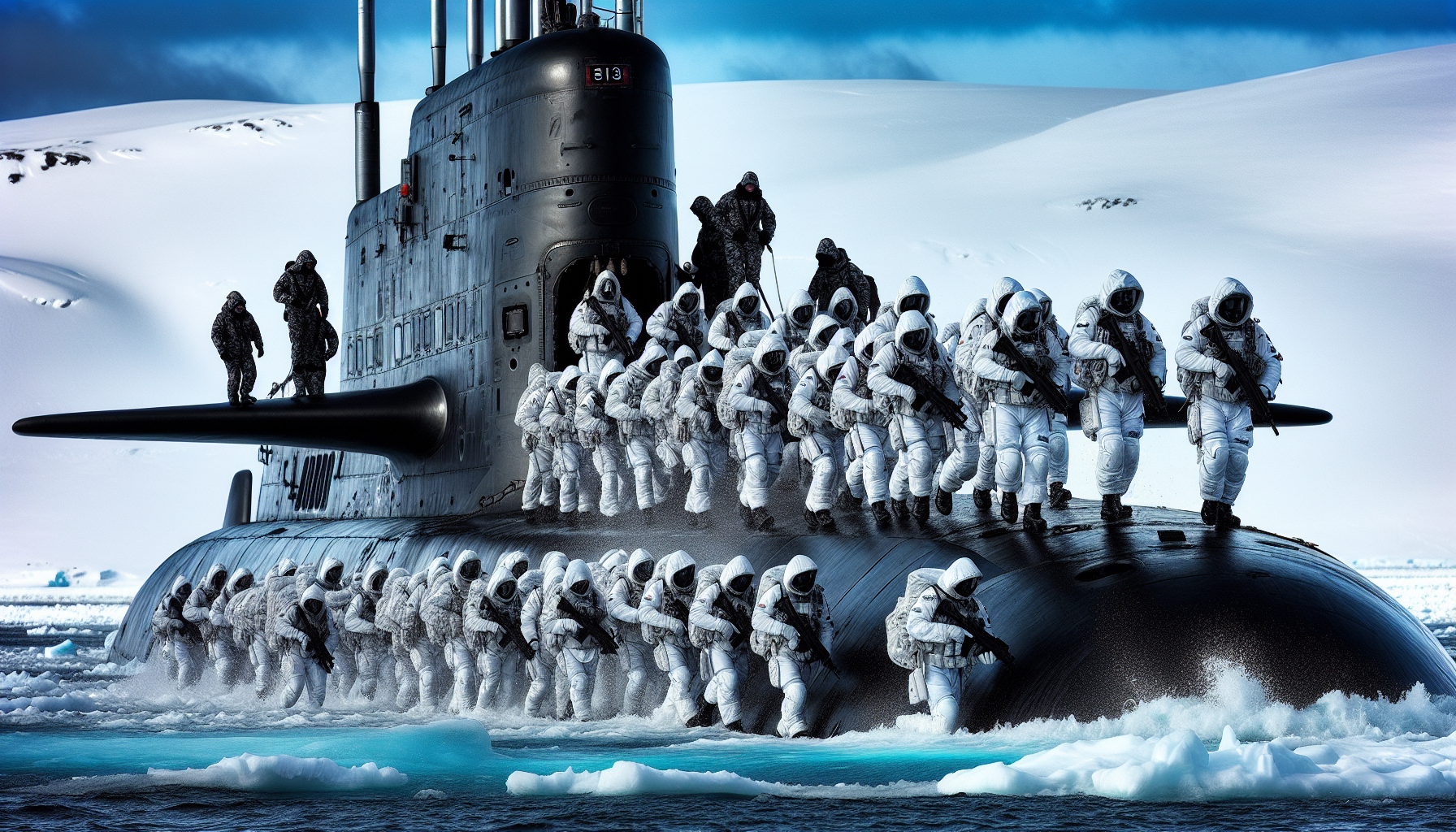
The operation’s highlights included the British Marines’ use of the German Navy’s U-35 submarine, a Type 212A boat. This impressive platform surfaced about 200 miles within the Arctic Circle, providing a launching point for a team to conduct a covert insertion into hostile territory. Utilizing Inflatable Raiding Craft, the Marines operated under the veil of darkness, a tactic aimed at minimizing detection and maximizing operational surprise.
The mission centered on reconnaissance and targeting operations, with the Marines tasked to observe a simulated enemy radar site. This intelligence-gathering effort was crucial for the effective execution of naval gunfire from allied warships, showcasing a seamless integration of multiple military assets. Participants in the exercise included the Surveillance and Reconnaissance Squadron, Shore Reconnaissance Troop, and the 148 Commando Forward Observation Battery—units specifically selected for their expertise in gathering intelligence and coordinating fires.
The significance of this operation extends far beyond mere cold-weather training. The tactical implications of employing a submarine for such missions present NATO with a significant advantage. Traditional methods of reconnaissance, such as aerial surveillance or surface vehicle approaches, can generate warnings and potentially compromise the element of surprise. However, by leveraging the stealth capabilities of the U-35, NATO forces are able to discreetly approach and assess coastal defenses, crucial for any military planning in the region.
In an environment characterized by unpredictable weather, challenging topography, and the constant risk of detection, getting observers ashore quietly transforms the dynamics of naval warfare. Covert operations enable allied forces to construct a comprehensive targeting picture without revealing their intentions prematurely, allowing commanders to remain agile during confrontations.
The operational integration demonstrated in this exercise further signifies a shift in NATO’s operational paradigm. The collaboration between British and German forces reflects an evolving concept of interoperability—no longer limited to simply coordinating communications but extending to actual hardware sharing. The Type 212A, with its low-signature profile and specialized capabilities for covert operations, exemplifies how one ally’s resources can enhance another’s tactical effectiveness, marking a new phase of alliance integration.
This reliance on non-British assets to execute pivotal missions raises questions about the current status of British naval forces. While collaborating with a German submarine serves to illustrate NATO’s unity, it simultaneously underscores the importance of maintaining sufficient national capabilities to fulfill operational needs independently. The effectiveness of maritime special operations, particularly in the High North, hinges on reliable access to advanced undersea platforms like those found in the Royal Navy’s fleet.
Strategically, the Cold Response 26 exercise is emblematic of a broader awakening within NATO regarding its northern flank. The Arctic and sub-Arctic regions are increasingly vital as their geographical and strategic relevance grows. These areas border maritime routes that are crucial for the security of Northern Europe and serve as a theater where Russia maintains a watchful eye. As such, submarine-launched reconnaissance units become integral to NATO’s operational strategy, allowing for agile responses to emerging threats.
The operation also reflects the broader transformation taking place within the Royal Marines themselves. Moving away from conventional warfare strategies, the UK Commando Force is now focused on developing smaller, specialized units adept at littoral maneuver and persistent disruption. This shift aligns perfectly with the operational profiles demonstrated in Norway, emphasizing discrete insertion, surveillance, and rapid reaction capabilities before larger forces become involved.
Ultimately, the visuals of Royal Marines emerging from a German submarine in a Norwegian fjord pack a powerful message, one that signifies NATO’s commitment to agility and operational readiness in the event of a confrontation with Russia. By rehearsing tactics that emphasize infiltration, covert observation, and the ability to direct fire support along critical coastlines, NATO not only reinforces its deterrent posture but also fortifies its collective security in a rapidly evolving geopolitical landscape.
Written by Teoman S. Nicanci – Defense Analyst, Army Recognition Group