


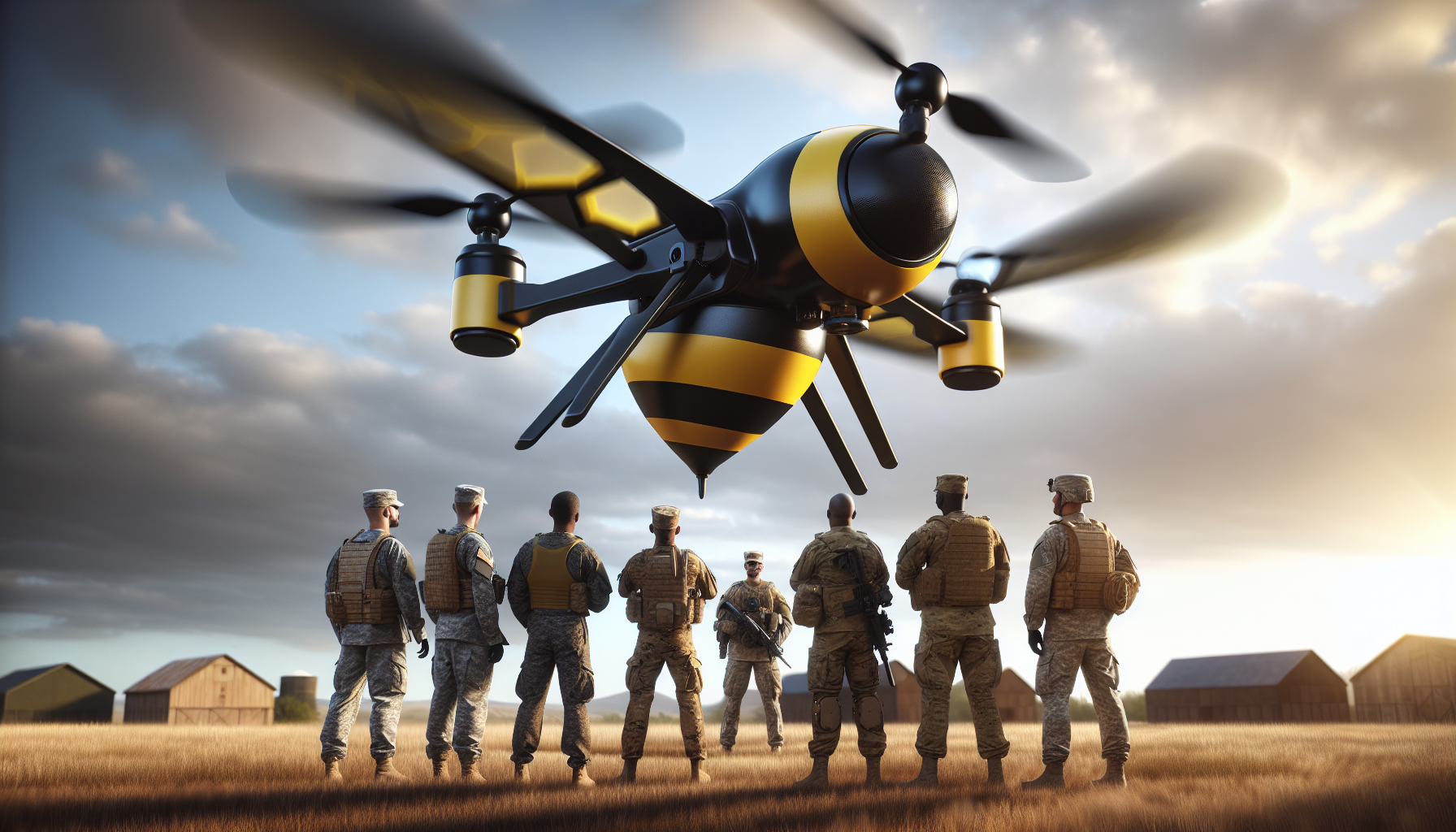
The U.S. Army’s Global Response Force is gearing up for a significant evaluation of the Bumblebee V2 drone interceptor, slated to commence in March. This undertaking comes on the heels of a $5.2 million contract awarded by the Pentagon on January 30. The Defense Department’s Joint Interagency Task Force 401 announced this exciting development on February 4, confirming that the first deliveries of the Bumblebee V2 will kick off next month.
The Bumblebee V2 is a state-of-the-art, first-person view drone equipped with four rotors, designed specifically as an autonomous hunter-killer system. Its most remarkable feature is its advanced artificial intelligence, which empowers the drone to identify and engage other unmanned aerial vehicles (UAVs) during combat. Uniquely, the Bumblebee V2 employs a collision tactic, crashing into enemy drones to neutralize them, thereby significantly reducing the risks associated with conventional explosive munitions, which can create hazardous blasts and debris.
Brig. Gen. Matthew Ross, the director of JIATF-401, highlighted the operational significance of this capability, stating, “This decision puts kinetic [counter-small] UAS capability into the hands of our troops immediately. The Bumblebee V2 provides a cost-effective, reliable interceptor that can neutralize threats without endangering our own forces or surrounding infrastructure.” In today’s complex battlefields, where drones are an ever-present threat, the capacity to use a low-collateral kinetic option is crucial for troop safety.
The strategic approach of the Bumblebee V2 is particularly relevant in urban warfare scenarios, where traditional hard-kill methods can pose severe risks. By opting for a direct collision over the use of bullets or explosives, the drone minimizes potential destruction and unwanted casualties among civilians and infrastructure. This innovative tactic aligns perfectly with the growing emphasis on reducing collateral damage in military operations.

Another important aspect of the Bumblebee V2 is its compliance with updated regulations outlined in the National Defense Authorization Act. This law imposes strict guidelines surrounding the use of foreign components in military technologies. This adherence not only facilitates the swift integration of drones like the Bumblebee V2 into the military but also echoes a similar commitment to domestic innovation seen in systems like the HANX drone, developed by the U.S. Marines.
The Army’s Global Response Force will undertake the evaluation of the Bumblebee V2 at the newly established Lt. Gen. James M. Gavin Joint Innovation Outpost. Launched on January 3 at Fort Bragg, this facility aims to enhance collaboration between soldiers, academic institutions, and private industry. By fostering such partnerships, the outpost serves as a critical hub for the development and testing of next-generation military technologies, ensuring that the U.S. Army remains at the forefront of modernization efforts.